
BESO Topology
Finds where a solid needs its material by BESO, bi-directional evolutionary structural optimisation. Model a block - the space the structure may take up - in SSP Bricks or tetrahedra, support it and load it as usual, and BESO Topology carves it down: it starts from the whole block and takes a little material away each iteration, from where it does least, until the share you allow is left.
It finds what Topology Optimisation finds, another way. Read that page first: the model, the run, Keep, Step and AlpacaModel work the same way here.
🔧 Grasshopper component
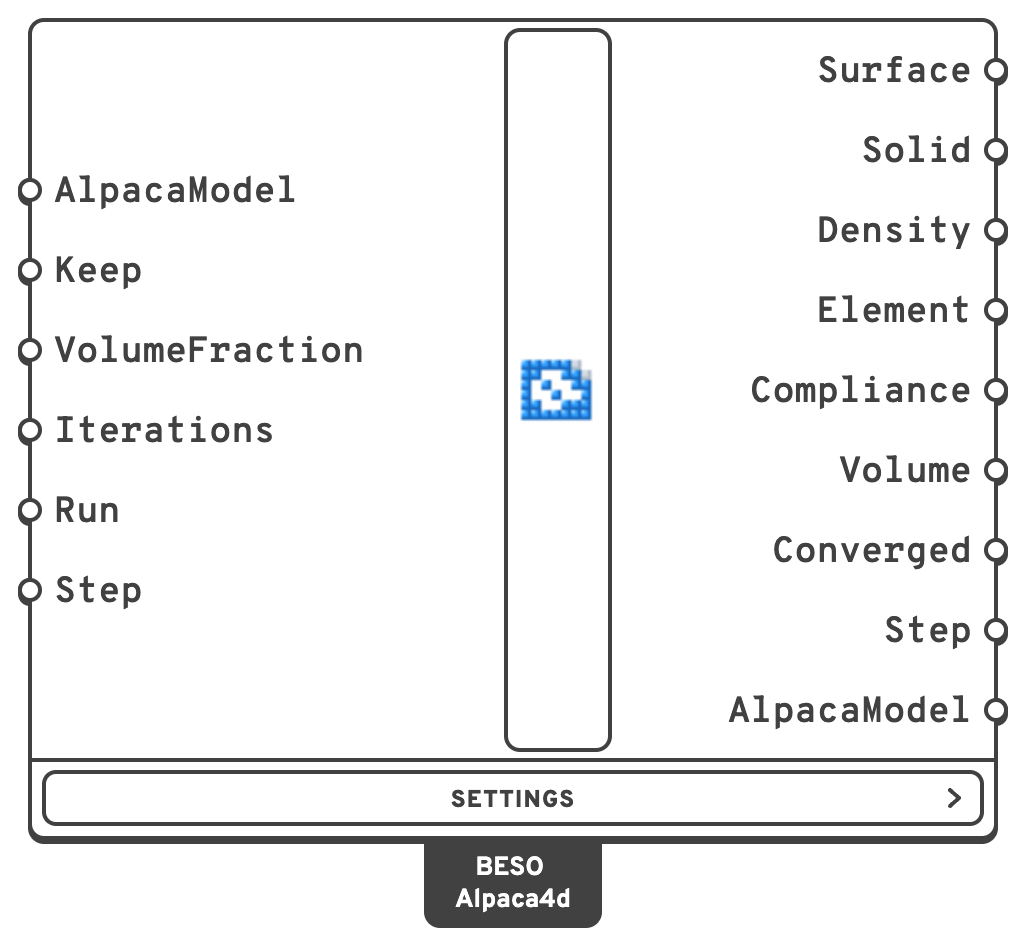
KeepSolids to keep solid whatever the optimisation finds, by ElementId, tag or pattern.
VolumeFractionThe share of the designed solids' volume to keep at the end.
IterationsHow many iterations at most.
true runs the optimisation, false pauses it.StepWhich iteration's design the outputs show: 0 the whole block the run starts from, 1 after the first iteration, and so on.
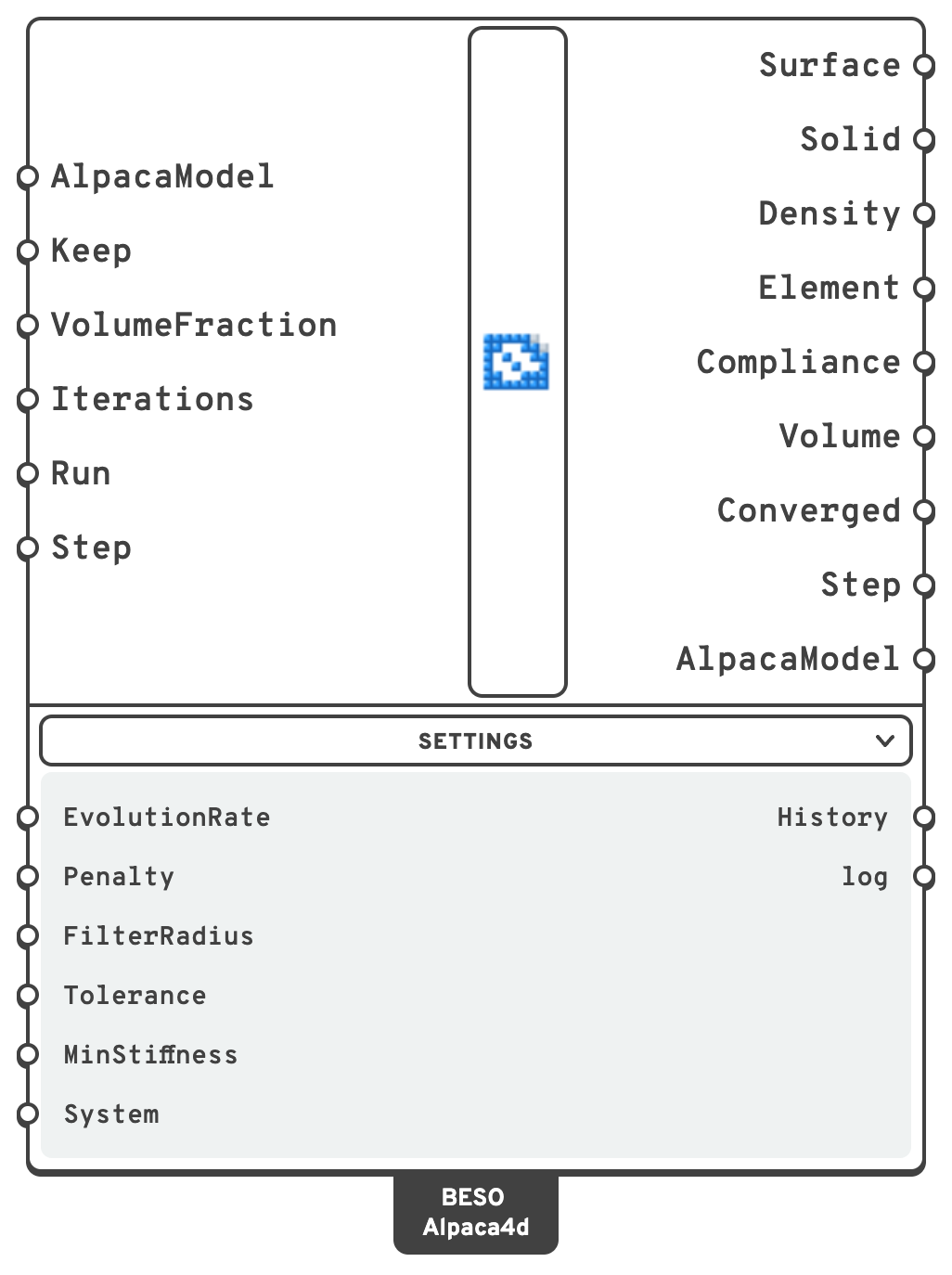
In the Settings menu:
| Input | Default | Description |
|---|---|---|
| EvolutionRate | 0.02 | How much of the volume each iteration takes away, as a share of the volume before it. Smaller is slower and steadier. |
| Penalty | 3 | The penalty p of soft-kill BESO: a void element has MinStiffness of its stiffness, and its strain energy counts MinStiffness^((p−1)/p) as much, next to nothing. |
| FilterRadius | 2 elements | How far the elements' strain energies are averaged over, in model units: about the thinnest member the result can have. Much wider, a thin member's energy is averaged away with the void around it, and the member can be cut through: see When a member is cut through. |
| Tolerance | 0.001 | Once VolumeFraction is reached, the run stops when the compliances of the last five iterations add up to within this share of the five before. Made smaller after a run, the run goes on from where it stopped. |
| MinStiffness | 1e-9 | The stiffness a void element keeps, as a share of the solid's. |
| System | Auto | The system of equations, as in Analysis Settings. |
There is no Threshold: every element is 1 or 0.001, so any threshold between finds the same solids.
SurfaceThe outline of the material kept: one closed mesh, capped where it meets the edge of the domain.
ComplianceThe work of the loads, F·u, of each iteration's design: the lower, the stiffer.
true when the run ended at VolumeFraction with the compliance settled within Tolerance.Every element is solid or void, all along. Where Topology Optimisation moves densities between 0 and 1 and settles on one design, BESO switches whole elements on and off, and the volume comes down from the whole block to VolumeFraction. So every iteration is a design of its own, of the volume reached, and Step shows each: drag it back to see the design with 80%, 60% or 40% of the material, and pick the one you want.
Nothing is ever cut out of the mesh. A void element keeps a billionth of its stiffness, so the model keeps all its nodes and connections, and an element can come back later.
Which elements
The same as Topology Optimisation: SSP Bricks, solved as OpenSees' eight point brick, and Ten Node Tetrahedra. Every solid needs an Elastic Isotropic material. Beams, trusses, shells and links are analysed with the solids but take no part.
⚙️ How it works
It is esoL.m, the BESO code of Xia, Xia, Huang and Xie's review (2018), step for step, in the soft-kill form of Huang and Xie (2009).
- The volume comes down. The whole block is solid at the start. Each iteration aims at the volume before it times 1 − EvolutionRate, until it reaches VolumeFraction, and stays there.
- Analysis. OpenSees solves the design; a void element has MinStiffness of its stiffness.
- Sensitivity numbers. Each element's strain energy per volume - for a void element x_min^(p−1) of it, next to nothing - says how hard it works.
- Filter. Each number is averaged over the elements within FilterRadius, so that void elements next to hard-working ones get a number too and can come back, and the result is members rather than a checkerboard. The solids in Keep take part with their own energy, as every element does in esoL: that is what holds a pad under a load to the structure.
- History. Each number is averaged with its value of the iteration before, which steadies the run.
- Update. A threshold is found by bisection: the design elements above it are solid, those below are void, and together the solid ones fill the volume aimed at.
- Stopping. Once VolumeFraction is reached, the run stops when the compliances of the last five iterations add up to within Tolerance of the five before.
When a member is cut through
As the volume comes down, members get thin. Now and then the update cuts one through, and the compliance jumps. Usually BESO mends it within a few iterations, bringing elements back, and the run goes on. When it does not - the compliance more than 10 times the lowest of the five iterations before, in one step or in two, and never back under 3 times that - the design has broken apart, the "breakdown" of Xia et al.'s section 3.4. The run then stops where it would have converged, Converged is false, and a warning gives the iteration: drag Step back to the last whole design, or start again with a smaller FilterRadius or EvolutionRate, or Keep more.
It comes mostly from too wide a filter. On the Topology Bridge block, at 2 bricks per metre, the default radius, 1 m, converges; 2 m, half the block's height, breaks after 62 iterations.
Without a license, BESO Topology runs on models of up to 500 elements, counting any beams, shells and links with the solids, as Topology Optimisation does, and the design it finds is analysed and drawn free up to the same 500. A larger model needs one: see License.
Note
Which to use. Topology Optimisation gives one design for one volume and is the quickest on small models; on large ones BESO, needing fewer iterations, finishes first (see How long it takes). BESO is solid or void from the start, which needs no threshold, and passes through every volume on its way down, so one run is a series of designs to choose from. On the same problem they find much the same structure.
Example
The BESO Bridge example carves the block of the Topology Bridge - 16 m long, 2 m wide and 4 m high, pinned along both ends of its bottom, its top layer a deck kept solid under 10 kN/m² - down to a fifth of its volume below the deck: two inclined legs from the supports into the deck, with a column near each end. 3 456 bricks, 105 iterations, under 20 seconds. Drag Step to go through the designs of every volume on the way down.
The Truss Node and the Beam-Column Joint examples find a node where members meet in space - nine members of a space truss, a column and four beams - with all three topology optimisations side by side.
🧪 Checked against the paper
BESO Topology was run against an independent BESO in numpy: esoL.m in three dimensions, with its own eight node brick, its own assembly and SciPy's solver, sharing nothing with the run through OpenSees but the problem and the algorithm.
- esoL's clamped cantilever,
esoL(100,50,0.6,0.02,6,2), as 100 x 50 bricks one brick deep: both runs take 39 iterations and end with every one of the 5 000 elements the same - the design of the review's Fig. 60. - A 3D cantilever, 40 x 20 x 4 bricks, to 40% of the volume: the two runs are the same to 1e-12 for 80 iterations; at iteration 81 one element sits on the threshold and goes the other way, round-off, and they end 0.06% apart, 3 192 of 3 200 elements the same.
The checks and the reference are in Alpaca4d.Test/TopologyMethods in the Alpaca4d repository: ./run.sh bench beso-cantilever runs the first.
📚 References
- L. Xia, Q. Xia, X. Huang, Y. M. Xie (2018). Bi-directional evolutionary structural optimization on advanced structures and materials: a comprehensive review. Archives of Computational Methods in Engineering 25:437–478. — esoL.m, which BESO Topology follows.
- X. Huang, Y. M. Xie (2007). Convergent and mesh-independent solutions for the bi-directional evolutionary structural optimization method. Finite Elements in Analysis and Design 43:1039–1049. — the filter, the averaging with the iteration before, the test of convergence.
- X. Huang, Y. M. Xie (2009). Bi-directional evolutionary topology optimization of continuum structures with one or multiple materials. Computational Mechanics 43:393–401. — soft-kill BESO.
Alpaca4d adds what a model drawn in Grasshopper needs, as in Topology Optimisation: elements of different sizes count by their volume, solids can be kept, and the energies come from OpenSees' element forces.