Fiber Section
Collects fibre points, layers and patches into one section.
🔧 Grasshopper component
Fiber Section (Alpaca4d) — Alpaca4d ▸ MomentCurvature_βeta, nickname FiberSection
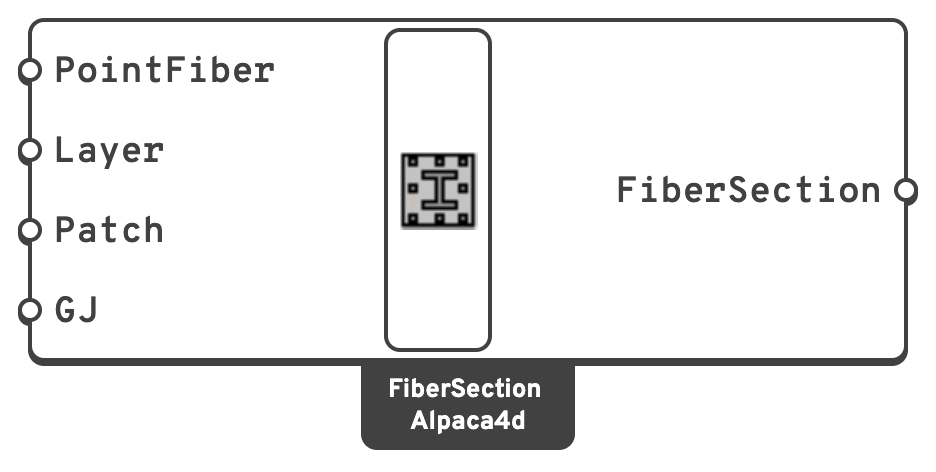
GJTorsional stiffness, in kN·m².
Local axes
The component draws the section's local axes at the area centroid of its fibres, steel included: the point OpenSees takes the section's moments about, and the Centroid of Interaction Domain.
| Arrow | Axis | World direction | Moment about it |
|---|---|---|---|
Green, labelled y, My | local y | world X | My |
Blue, labelled z, Mz | local z | world Y | Mz |
Red ⊙, labelled x | the beam's axis, x = y × z | world Z, out of the drawing | — |
That is the order OpenSees writes a fibre in. Draw the section in the world XY plane and the mapping takes care of itself; the arrows are there to confirm it.
My is the moment about y, Mz the moment about z, by the right-hand rule with x coming out of the drawing, towards you in the Top view. The double arrowheads are a moment vector's. So:
| Positive | Stretches | Squeezes |
|---|---|---|
| My | the fibres on the +z side | the −z side |
| Mz | the fibres on the −y side | the +y side |
This is the convention of Moment Curvature, whose Direction 0 bends the section about y and 90 about z, of Interaction Domain and Domain Check, and of the views, which draw My along X and Mz along Y, as the arrows here lie.
The preview also shows every fibre the section contains, so a patch whose mesh is too coarse or a layer pointing the wrong way is visible before anything is run.
📈 When to use it
Use it when you want a section whose non-linear behaviour comes out of its materials.
Do not use it when the element is a beam — fibre sections cannot yet be assigned to a ForceBeamColumn, which takes an elastic section. Today this is a section-level tool.
Note
GJ is a fixed elastic number. A fibre section integrates axial and bending response from its fibres but has no torsional stiffness of its own, so it has to be given one. The default 1e8 kN·m² is deliberately large: with the section under pure bending, torsion never engages, and the value only matters if the section is ever used somewhere that torsion does.
🔗 Relation to OpenSees
section Fiber $secTag -GJ $GJ {
    fiber $y1 $z1 $A1 $mat1
    fiber $y2 $z2 $A2 $mat2
    ...
}
Patches and layers are expanded into individual fiber lines. Use Serialize to see the result.