Hinge Release
A hinge release is the DOF pattern of one beam end. It is consumed by the WithHinges unit of the ForceBeamColumn component, and by nothing else.
🔧 Grasshopper component
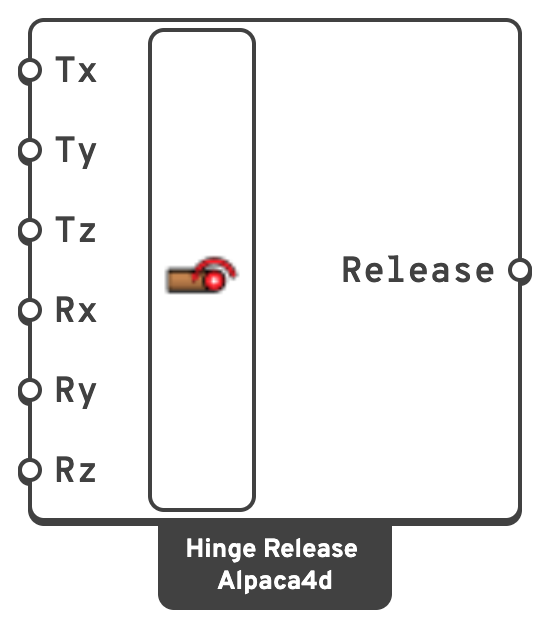
TxAxial translation along x.
false = released.false = released.false = released.RxTorsional rotation about x.
false = released.RyRotation about y (bending).
false = released.RzRotation about z (bending).
false = released.Warning
The sense is inverted relative to what the word "release" suggests: true means held, false means released. It reads the same way as the booleans on Support, which is why it is that way round.
ReleaseI or ReleaseJ input of a WithHinges beam.📈 When to use it
Use it when
- You need a pinned beam end: set
RyandRztofalse. - You need a moment release about one axis only.
- You are building a member that carries axial force only.
Do not use it when
- The member is fully continuous — leave
ReleaseIandReleaseJempty and the ends are taken as fixed.
🔗 Relation to OpenSees
There is no OpenSees release command. A released DOF becomes a hinge section with that property scaled by 10⁻⁶, placed by HingeRadau — see Beam With Hinges for the mapping from each boolean to the section property it softens.
Because the hinge is a very soft section rather than a true free end, the release is approximate. Its accuracy depends on Lp/L, which is why that ratio is clamped.