Path
A path time series is defined by a list of times and a list of values, with linear interpolation between them. It reproduces arbitrary signals: recorded ground motions, measured forces, anything you can express as numbers.
🔧 Grasshopper component
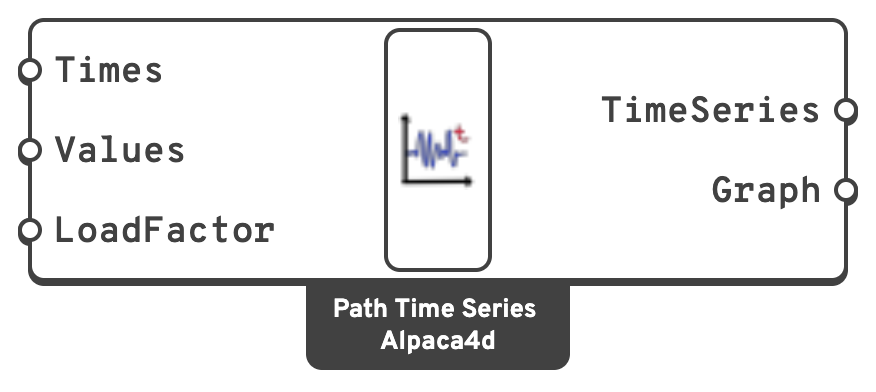
Path Time SeriesAlpaca4d ▸ 04_Time Series
Inputs
TimesTimes
s. Ascending, and the same count as Values.ValuesLoad factors
LoadFactorGlobal scale
Outputs
TimeSeriesPath series, for a Load Pattern.
GraphThe values, for plotting.
📈 When to use it
Use it when
- You need a recorded time history — earthquake acceleration, a measured force or displacement.
- The signal is generated in Grasshopper and is not analytic.
- You want full control over the shape of the excitation.
Do not use it when
- The signal lives in a file → Read Time Series parses it for you.
- A constant or a ramp will do → Constant or Linear.
- The loading is purely harmonic → Trigonometric is one number instead of a list.
🔗 Relation to OpenSees
tcl
timeSeries Path $tag -time {t1 t2 ... tn} -values {v1 v2 ... vn} -factor $cFactor -useLast-useLast is always written: past the last time in the list, the factor holds at the final value rather than dropping to zero. If you want the excitation to stop, end the list with a zero.