Deserialise
Reads an OpenSees .tcl deck back into an Alpaca4d model — the reverse of Serialize. The result behaves like a model from Assemble: preview it, analyse it, read results off it.
🔧 Grasshopper component
DeserialiseAlpaca4d ▸ 10_Utility
Inputs
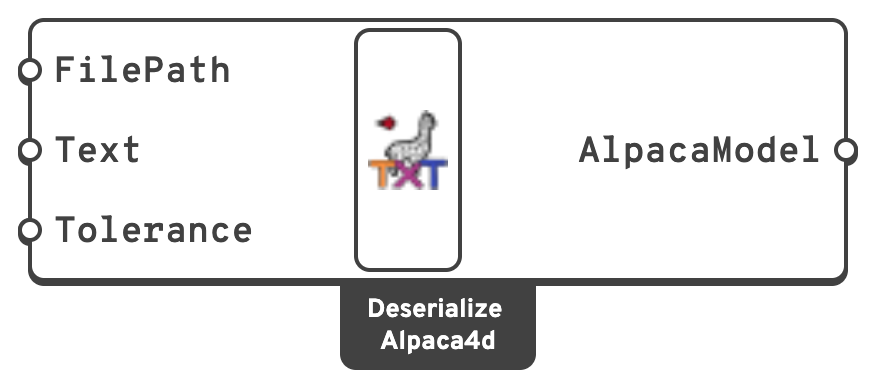
FilePathPath of the
.tcl file to read.TextThe contents of a .tcl file, as text.
Used when no FilePath is given.
ToleranceDistance below which two node positions are treated as the same node, in m.
Same meaning as on Assemble.
Outputs
AlpacaModelThe assembled model. Plug it into Model View to see it, or into Run Analysis to solve it.
💡 What it understands
| Category | Commands |
|---|---|
| Model | model, node, fix, mass |
| Materials | uniaxialMaterial Elastic, nDMaterial ElasticIsotropic, nDMaterial ElasticOrthotropic |
| Sections | section Elastic, section PlateFiber |
| Elements | element forceBeamColumn, ASDShellQ4, ASDShellT3, ShellDKGT, ShellNLDKGT, SSPbrick, FourNodeTetrahedron |
| Transformations | geomTransf |
| Time series | timeSeries Constant, Linear, Trig, Triangle, Path |
| Constraints | equalDOF, rigidDiaphragm, rigidLink |
| Loads | pattern and its contents |
Anything else in the file is skipped. A deck using a material or element Alpaca4d does not model will come back missing those parts, quietly — check the result in Model View before trusting it.
📈 When to use it
Use it when
- Someone hands you an OpenSees model and you want to see it, or re-use its geometry.
- You have an older deck and want it back inside the parametric workflow.
- You edited a deck by hand and want to check what you actually changed.
Do not use it when
- The model was built in Grasshopper in the first place. A round trip through Tcl loses everything the deck does not carry.
Note
equalDOF is read back as an Equal DOF. The ones Assemble writes on its own, where a solid meets a beam or a shell, are skipped, so the next assembly does not add them twice. twoNodeLink is not read back: a model with Spring Links comes back without them, with a warning.