Beam Stresses
The stresses along every beam element — axial, bending about each axis, the extreme direct stress, shear and torsion, and the Von Mises equivalent — recovered from the beam forces with elastic beam theory.
They depend on the section's shape, not its material: this is what a linear elastic section of that shape carries under those forces. To check them against a strength, use Utilisation.
🔧 Grasshopper component
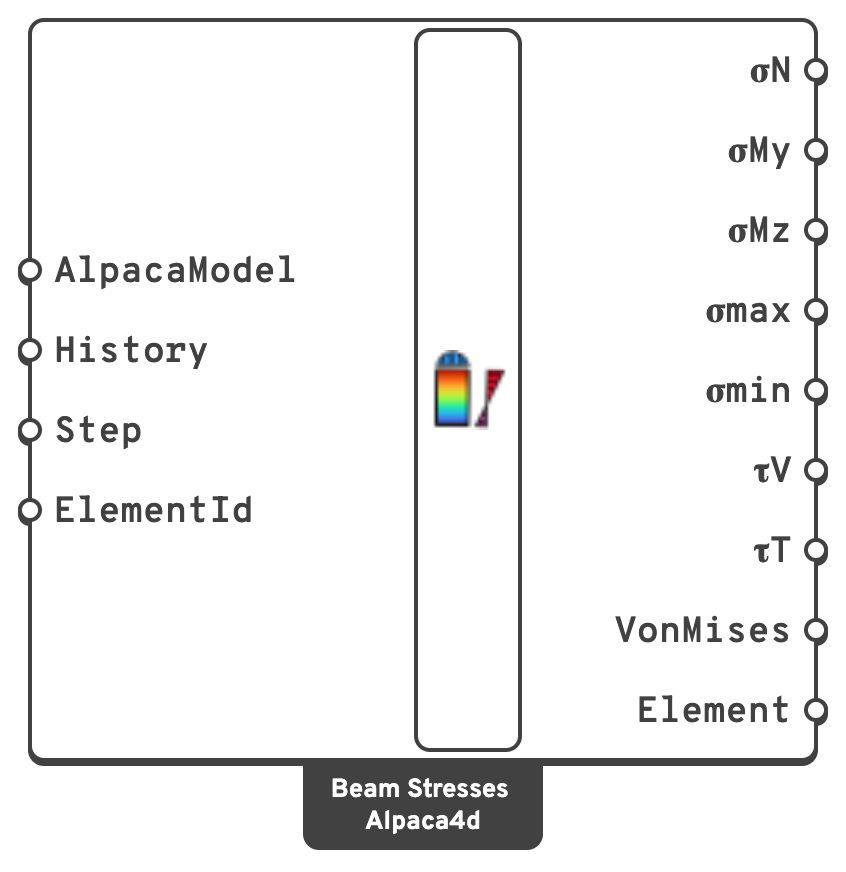
HistoryRead every recorded step instead of one.
{step; element}. Step is ignored.ElementIdRead only some of the beams: an ElementId, a wildcard over them, a tag, or a regular expression.
All are data trees, one branch per beam element, keyed by its tag — the same layout as Beam Forces. Within a branch, the values are at the element's integration points, from the I end to the J end.
Stresses are in MPa (N/mm²) — the unit steel and timber strengths are tabulated in, rather than the model's kN/m², which would read a thousand times larger.
💡 How the stresses are worked out
Direct stress. σ = N/A − Mz·y/Iz + My·z/Iy, with y and z measured from the centroid — the convention OpenSees bends its fibre sections by, so a positive Mz compresses the +y side. It is checked at every corner of the shape, which is where a linear stress over a polygon has its extremes, and exactly for a round section. An I with unequal flanges or a pair of angles has its centroid away from the middle of the drawing, and the stresses are measured from it.
Shear and torsion. τ from Vy and Vz is the peak of the textbook (Jourawski) distribution, V·S / (I·b), worked out piece by piece so that each flange outstand of an I carries its own share. Torsion uses each shape's own formula:
| Shape | τ from V | τ from T |
|---|---|---|
| Rectangular | 1.5 V/A | Saint-Venant, within 0.5% of the tables |
| Circular, solid or tube | across a diameter: 4V/3A solid, → 2V/A thin | T·R / Ip |
| Rectangular Hollow | through both walls | Bredt, T / (2·Am·t) |
| I Section | mid-web for Vy, each flange outstand for Vz | T·t / J, J = Σ b·t³/3 |
| Double L-Angle | both long legs for Vy, the short leg's root for Vz | T·t / J |
Warning
Von Mises is conservative, mostly. It puts the worst σ with the worst τ, which rarely meet: bending peaks at the corners, where a free surface carries no shear, and shear peaks on the neutral axis, where bending is zero. Close to exact on slender members, conservative on short deep ones. It is not a strict bound: τV puts the peaks from Vy and Vz together as √(τy² + τz²), but where both act their shear flows can add along one wall of an I or a box, and the shear there is then higher than τV — by about a fifth on a box sheared equally both ways, and by a few percent under Vz alone on a box whose side walls are thinner than its flanges.
Note
A Generic Section is a list of properties with no shape behind it, so its beams give σN only; their other branches are empty, and the component says so.
📈 When to use it
Use it when
- You want the stress in a beam rather than the force, to compare members of different sections.
- You need σ and τ separately — a timber check, say, treats bending and shear apart.
Do not use it when
- You want a code check of steel members → Utilisation.
- You want to see the stresses → Model View, with Beam stresses ticked, colours the beams along their length — and, with Extruded on, paints the components that vary across the section point by point over it.
✅ How it is checked
The direct stresses are compared, fibre by fibre, with the stresses OpenSees integrates in elastic fibre sections — a round bar, a tube, an IPE 300, an unequal I and a pair of angles — to within the fibre mesh, a few hundredths of a percent. The shears and torsion match the published worked examples of Hibbeler's Mechanics of Materials to every digit printed.
Exact elasticity (a finite element solution of the cross-section) reads the shear from V up to 10% higher on thick round tubes, and about 4% on solid bars and thin tubes: Jourawski takes the shear as uniform across a cut, and on a circle it is not. That is beam theory, not a bug — it is what textbooks and EN 1993-1-1 6.2.6(4) use.