Double L-Angle
Two equal L-angles placed back to back with a gap between them — the usual arrangement for a truss chord or a bracing member bolted through a gusset plate.
🔧 Grasshopper component
2LAngleCS (Alpaca4d) — Alpaca4d ▸ 01_Section, nickname 2L
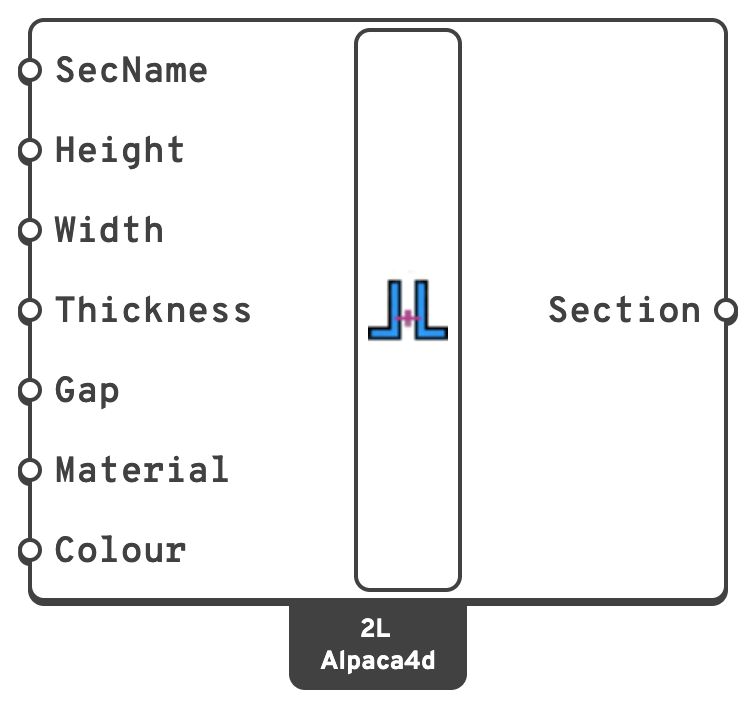
Inputs
SecNameSectionNameLabel for the section.
HeightFirst leg dimension, in
m.WidthSecond leg dimension, in
m.ThicknessLeg thickness, in
m.GapClear distance between the two angles, in
m — typically the gusset plate thickness.MaterialA Uniaxial material.
ColourThe colour the section is drawn in when Model View colours the elements by section.
Left empty, Model View gives each section a colour of its own. Display only: the analysis never reads it.
Outputs
SectionBeam section, for a ForceBeamColumn.
📈 When to use it
Use it when
- The member is a back-to-back double angle: truss chords and diagonals, bracing, light lattice members.
Do not use it when
- The profile is a catalogue angle → Steel Section Library, family
2L, which has 87 of them and exposes the same Gap input. - The two angles are not connected along their length. This section assumes they act compositely; two separate members would be the honest model.
🔗 Relation to OpenSees
tcl
section Elastic $secTag $E $A $Izz $Iyy $G $J $alphaY $alphaZThe properties are those of the pair, computed about the combined centroid, with the angles offset by Gap/2 either side of the local z axis.