Patch
An area of the section filled with fibres — one fibre per mesh face, at its centroid. This is how the concrete part of a section is defined.
🔧 Grasshopper component
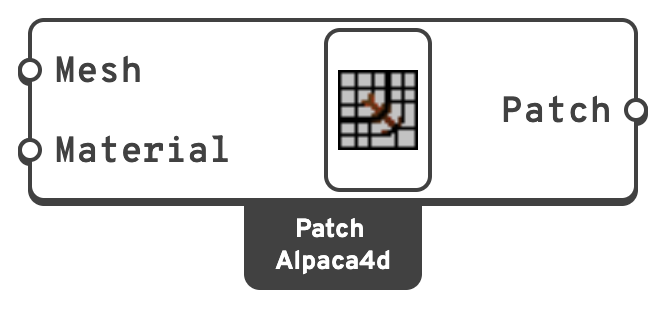
m, in the section's local yz plane.Patch input of Fiber Section.The component previews the mesh wireframe in grey and the fibre centroids in black.
Warning
The mesh density is the fibre density. Each face becomes one fibre at its centroid, with that face's area. There is no separate subdivision input — to refine the section, refine the mesh.
Concentrate the faces where the strain gradient is steep, which for a section in bending means the extreme compression fibre. Ten to twenty divisions through the depth is a usual starting point; a mesh two faces deep will not resolve the neutral axis.
📈 When to use it
Use it when
- You are defining the concrete of a reinforced-concrete section.
- You are modelling any solid region of a section — a steel web, a timber body, an infill.
- You want a different material in the core and the cover: mesh them as two patches, and give the core patch a higher
fcuand largerEpsilonCuto approximate confinement.
Do not use it when
- The fibres are discrete bars → Layer Fiber or Fiber Point.
Note
Patches and bars overlap: a bar sitting inside a concrete patch is counted twice, once as concrete and once as steel. For ordinary reinforcement ratios the error is small and usually ignored. If it matters, reduce the bar areas by the concrete they displace.
🔗 Relation to OpenSees
The patch is expanded into individual fibres inside the enclosing section Fiber block:
fiber $yLoc $zLoc $area $matTag