⛰️ 10. Summit bridge
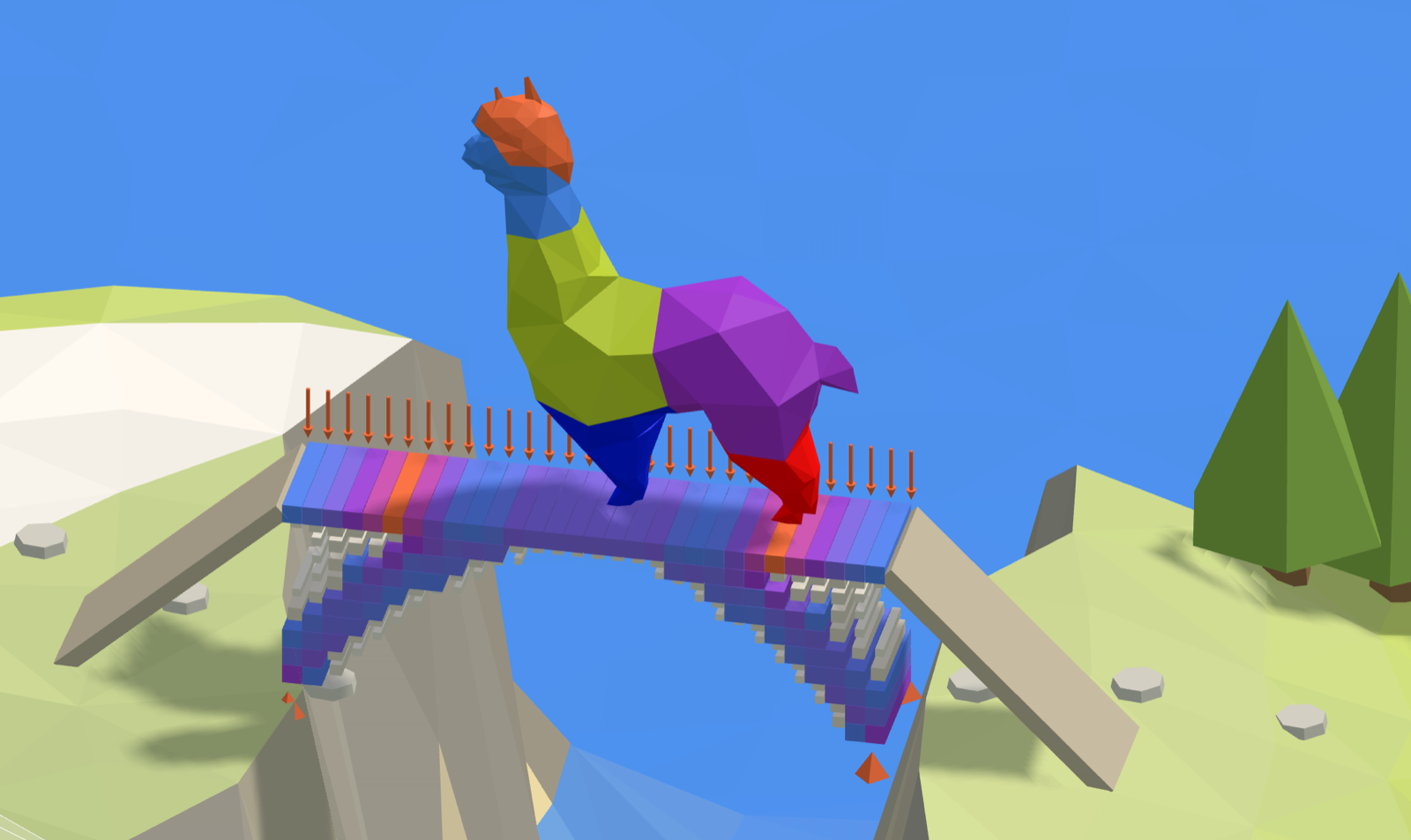
The lightest concrete bridge across the chasm at the summit, carved out of a block of bricks by Topology Optimisation.
The lightest bridge. A block of concrete fills the chasm at the summit, pinned to the rock at both ends. Topology Optimisation keeps a quarter of it, only where the forces flow, and finds an arch.
GHsummit-start.ghGrasshopper file · download
GHsummit.ghGrasshopper file · download
Start from summit-start: the block, its concrete, the rocks and the walkway are there, and the steps below add the rest. summit is the finished definition: it runs as it opens, in about a second. The same bridge is the last area of the Playground, where you build it a piece at a time and watch what each wrong piece would carve.
What you will learn
- How Topology Optimisation works: a block of solid elements, the design domain, of which it keeps the share you allow, where it makes the structure stiffest.
- What Keep and VolumeFraction do, and why the deck has to be kept.
- Why supports shape the result: rock that pushes back gets an arch, a roller gets a tie.
The block
The chasm is 12 m across. The block that fills it is 4 m deep and 1.2 m wide, in C30/37 concrete (E = 33 000 MPa, 2.5 t/m³), cut into 30 × 10 bricks of 0.4 m: 300 bricks, 144 t. Topology Optimisation runs without a license on models of up to 500 elements. A walkway of 5 kN/m² stands on its top row, the deck. Alpaca4d works in metres and kilonewtons (Units).
Steps
- The block. Open summit-start. Plan is the deck's plan, 12 × 1.2 m, and Plan mesh cuts it into Along faces, 30. Heights copies it up to 11 levels, 0.4 m apart, and Mesh Series to Brick makes a layer of bricks between each level and the next: 10 layers need 11 levels. It makes them from the bottom up, so the deck's 30 bricks are the last.
- Concrete. Split List cuts the bricks at Deck starts, 30 × 9 = 270: the first 270 into the SSP Brick named Domain, the last 30 into the one named Deck. Both take the C30/37 nD material. The name in ElementId is how Topology Optimisation will find the deck.
- The rocks. Two Supports, Rock A at X = 0 and Rock B at X = 12, each at both edges across, at the bottom of the block. Free frees Rx, Ry and Rz, which a brick's node does not have anyway; Tx, Ty and Tz are held at both, so the rock pushes the bridge back in.
- The walkway. 5 kN/m² × 12 m × 1.2 m = 72 kN, shared by the 62 nodes of the deck's top that Deconstruct Mesh gives: 1.16 kN each, down, as Point Loads in a Load Pattern.
- Assemble. Into Assemble Model: the Domain and the Deck into Elements, both rocks into Supports, the Load Pattern into LoadPatterns. Hold Shift to wire a second source into the same input.
- What it keeps. A panel Keep holding
Deck, and a slider Share kept at 0.25. - Topology Optimisation. Wire the model into Topology Optimisation's AlpacaModel, Keep into Keep, Share kept into VolumeFraction, a toggle Run set to True into Run, and a slider Step into Step. It runs: 40 iterations, about a second. Drag Step back to watch it again.
Check it by hand
What it keeps. VolumeFraction counts only the bricks it designs; the ones in Keep come on top. A brick is 0.4 × 1.2 × 0.4 = 0.192 m³, 0.48 t:
of the block's 144 t. The design that comes out, the 90 bricks at a density of 0.5 or more, is 43.2 t.
The push on the rock. An arch carrying w = 5 × 1.2 = 6 kN/m over L = 12 m, rising f = 3.8 m from the foot of the rock to the middle of the deck, pushes each wall out with
OpenSees gives 26.8 kN on the design: the deck carries some of the walkway itself. Group 8 of summit.gh analyses the design once the run has stopped, and colours it by Von Mises stress. Its 90 bricks are past the 50 elements Run Analysis and Model View take without a license, but a design that came out of Topology Optimisation is analysed and drawn free up to the 500 the optimisation took.
Try
- Free Rock B along X: wire Free into its Tx. Nothing pushes the ends together any more, so the optimiser ties them with a row of bricks along the bottom: a bowstring, 3.6 times as flexible, with its tie in tension.
- Hold it at the top: wire Depth into the Z of both feet. The bridge hangs between the tops of the walls, and the optimiser finds a hanging shape, 2.3 times as flexible. Concrete wants pushing.
- Carry the alpaca alone: one point at the middle of the deck instead of the walkway. It finds two struts meeting under that one spot.
- Change Share kept: 0.4 makes a heavier, stiffer arch; 1 keeps the whole block.
The usual mistakes
| You see | Why | Fix |
|---|---|---|
| Point load at location '0,0,4' is not part of the model!, and Deck orange | Up wired straight into Heights' Count: 10 levels make 9 layers, so the block is 3.6 m deep and has no deck. | n layers need n + 1 levels: Up + 1. |
| Without a license Topology Optimisation takes models of up to 500 elements | Too fine: 60 × 20 bricks is 1 200. | 0.4 m bricks, 30 × 10, show the shape. |
| The walkway crumbles at both ends | Keep is empty, so the deck is designed too. | Keep Deck. |
| "Dek" matched none of the 300 elements that have an ElementId | A misspelt name in Keep. Case does not matter. | Spell it as in ElementId. |
| The walkway is gone, the block below solid | The Deck and Domain names swapped, so Keep holds the block below. | Deck on the top row. |
| No part of the design is held still by the supports, so AlpacaModel is empty. | Share kept too small: 0.05 cannot reach from the deck to the rock. | 0.25. |
| Set Run to true to start the optimisation. | Run is False. | A toggle set to True into Run. |
| A tie along the bottom | Rock B on a roller: nothing pushes the ends together. | Hold Tx at both rocks. |
The components
- Mesh Series to Brick · SSP Brick · nD · Support · Point Load · Load Pattern · Assemble · Topology Optimisation · Run Analysis · Model View
See also
- Find a structure with topology optimisation
- Topology Bridge, the same idea in steel, 16 m long
- 9. Wall with a window: the stress lines that a topology follows