nD
An nD material (n-dimensional) describes the full 2D/3D stress–strain law at the Gauss point of a continuum element. Shells, bricks and tetrahedra all need one.
🔧 Grasshopper component
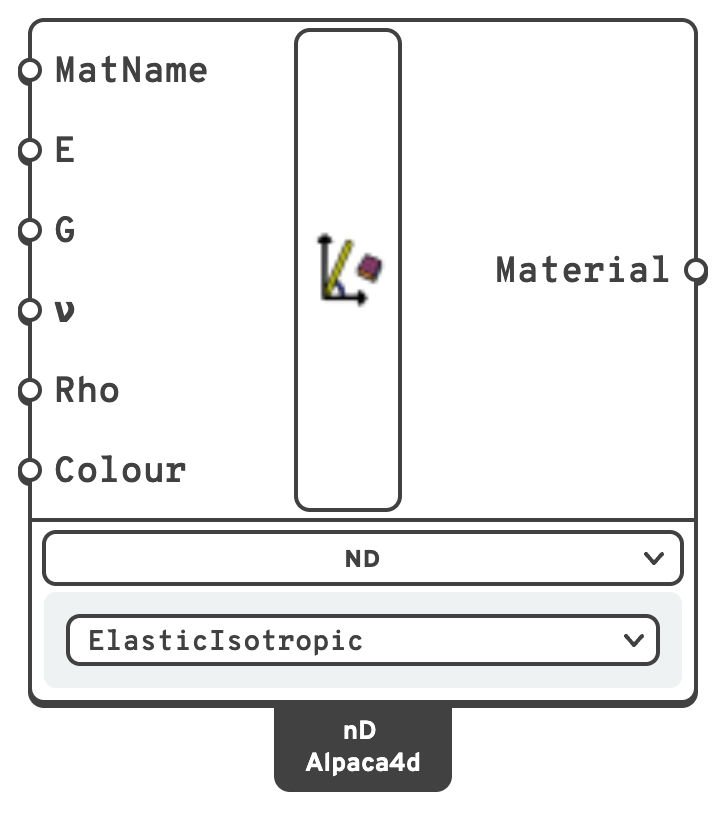
kN/m².kN/m².kg/m³.ColourThe colour the material is drawn in when Model View colours the elements by material.
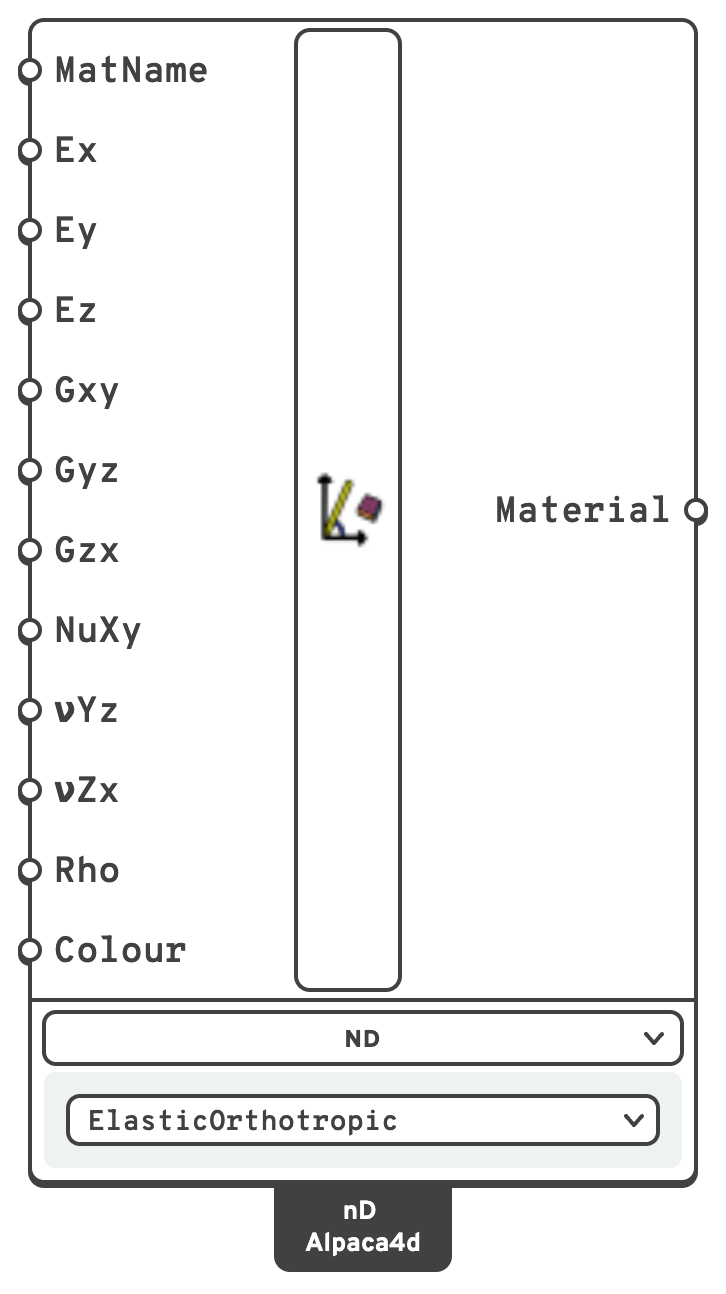
kN/m².kN/m².kN/m².kN/m².kN/m².kN/m².kg/m³.ColourThe colour the material is drawn in when Model View colours the elements by material.
Note
G on the isotropic unit is not written to OpenSees — ElasticIsotropic derives its shear modulus from E and ν. Alpaca4d keeps G on the material because the same material object may also be read for section properties.
Note
Rho is in kg/m³, and it is what gives shells and solids their mass.Shells, bricks and tetrahedra take no mass input of their own — OpenSees reads the density straight off this material. Alpaca4d converts it to the solver's mass unit when the deck is written.
Before 0.11 that conversion was missing, so every shell and solid was a thousand times too heavy and modal frequencies came out about 31.6 times too low. Static results were never affected — density only feeds the mass matrix, and self-weight is applied as explicit nodal loads by Gravity Load.
A switcher component: pick the unit in the drop-down under it, or right-click it ▸ Units:
- ElasticIsotropic — the same stiffness in every direction.
- ElasticOrthotropic — different stiffness along three orthogonal directions, for timber, composite panels, or plates that behave differently in-plane and out-of-plane.
📈 When to use it
Use it when
- The element is a shell, a brick or a tetrahedron.
- You need direction-dependent stiffness — timber panels, laminates, ribbed slabs smeared into an orthotropic plate → use ElasticOrthotropic.
Do not use it when
- The element is a beam → use a Uniaxial material.
- You want a standard isotropic grade → the Material Database will produce one directly.
🔗 Relation to OpenSees
nDMaterial ElasticIsotropic   $matTag $E $nu $rho
nDMaterial ElasticOrthotropic $matTag $Ex $Ey $Ez $nuXy $nuYz $nuZx $Gxy $Gyz $Gzx $rho
For the orthotropic material on shells, the axes are those of the shell section — axes 1 and 2 of Local Axes in Model View. On solids they are the global axes. On shells, set Local X Axis on the ASD Shell component so every face agrees on which direction Ex refers to.