Gravity
Applies the self-weight of every element in the model, derived from the material density and the section or thickness.
🔧 Grasshopper component
1.0 is plain self-weight; 0.0 disables it; 1.35 gives a factored permanent load; values above 1 are also a quick way to include finishes not modelled explicitly.There is no geometry input. Gravity applies to the whole model, and its direction is −Z. Model View, with Show Loads on, draws it as OpenSees is given it, in the Gravity colour: a line load along each beam, and a point load down on each node of the rest.
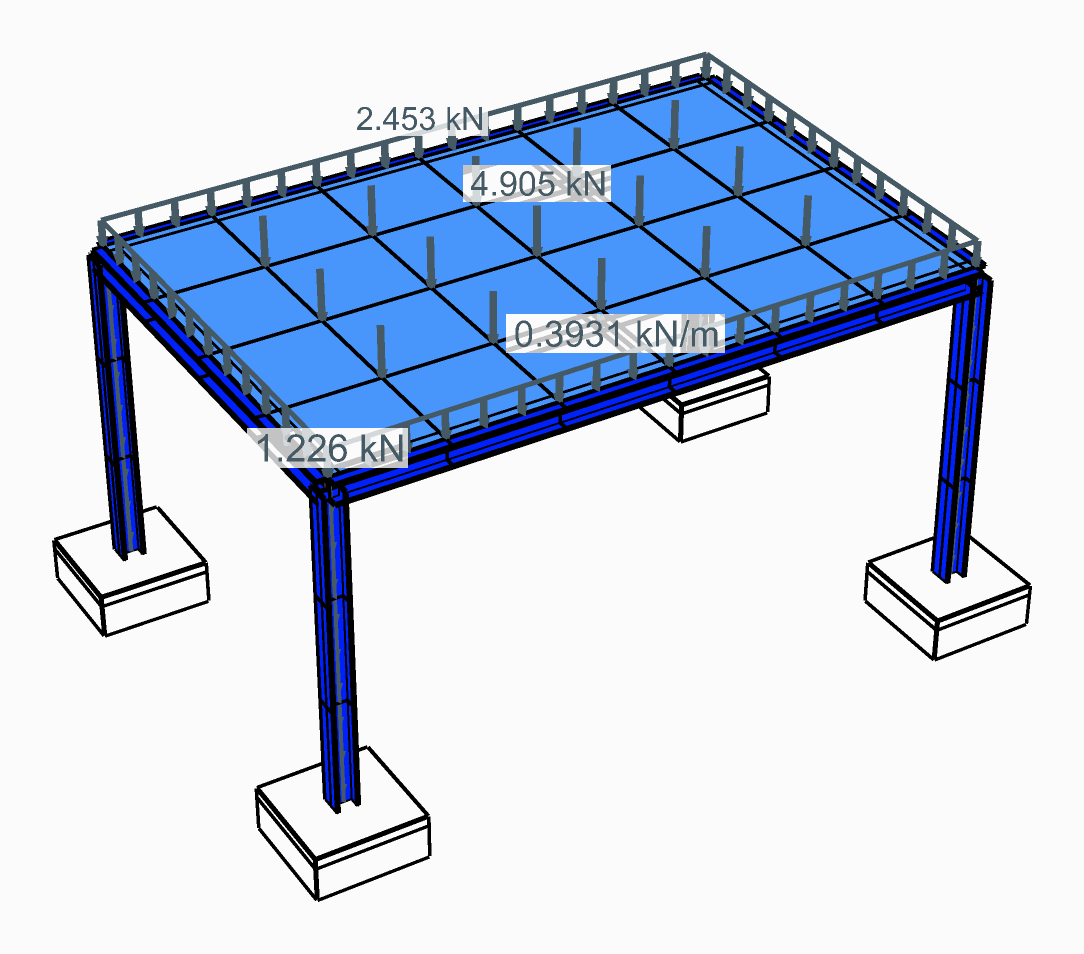
A steel frame's own weight along its members, 0.393 kN/m, and the slab's on its nodes: 4.905 kN inside, half on an edge, a quarter at a corner
📈 When to use it
Use it when
- Any model where self-weight matters. Put it in its own permanent pattern (a "G" case) and combine it with the others.
Do not use it when
- You are modelling weight that is not in the elements — plant, finishes, a stored material → use Point Load, Beam Load or Shell Load, and Mass Point for the dynamic side.
Note
A beam carries its weight along it, as a uniform load, so a beam of one element bends under it: w L² / 8 at the middle of a simply supported span. A truss has no bending to carry a load along it with, so half its weight goes on each end, as a Linear Load on it does.
🔗 Relation to OpenSees
Gravity is resolved by Alpaca4d during assembly rather than written as its own command. Each element's weight becomes loads inside the enclosing pattern: an element load along each beam, and load entries on the nodes of everything else.
pattern Plain $tag $tsTag -fact $factor {
    eleLoad -ele $beamTag -type -beamUniform $Wy $Wz $Wx
    load $nodeTag 0.0 0.0 -$w 0.0 0.0 0.0
    ...
}
A beam's load is A × ρ × g per metre, straight down, written in the beam's local axes as a Linear Load is. A truss's weight, A × ρ × L, goes half on each end. A shell's, t × ρ × area, is split between its nodes. A solid's, ρ × volume, is shared equally among its nodes, except a Ten Node Tetrahedron's: −1/20 of it on each corner and 1/5 on each edge node, the way the element shares a body force.