
Spring Link
A spring link is an element between two nodes that are apart. It carries one uniaxial spring per local direction, and nothing at all in the directions left out. It models a connection with a real stiffness: a bearing, a bolt, a damper, the interlayer of laminated glass.
🔧 Grasshopper component
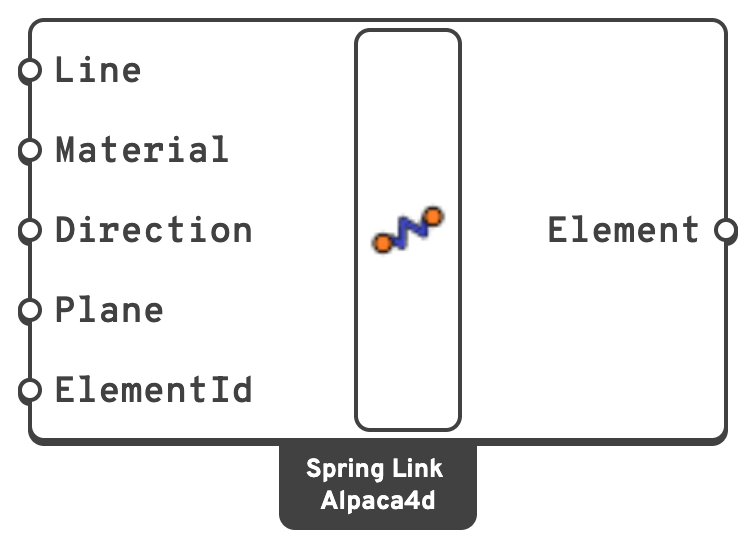
LineOne line per link, from the node it starts at to the node it ends at, in m.
MaterialOne uniaxial material per direction, in the order of Direction.
E is read as a stiffness: kN/m for a translation, kN·m/rad for a rotation.DirectionThe local directions that carry anything: 1, 2, 3 translation along local x, y, z; 4, 5, 6 rotation about them.
PlaneThe frame the directions count in.
ElementThe links, for the Elements input of Assemble.
The six directions
| Direction | In the local frame | Acts as |
|---|---|---|
1 | translation along x | the axial spring, along the link unless a Plane says otherwise |
2, 3 | translation along y, z | the shear springs, across the link |
4 | rotation about x | torsion |
5, 6 | rotation about y, z | bending |
A link on direction 1 alone pulls along its own axis and resists nothing else. On a solid's node only 1 to 3 exist, because a solid node has no rotations.
📈 When to use it
Use it when
- A connection has a stiffness you know: an elastomeric bearing, a bolt group, a flexible joint between two parts of the structure.
- Some directions should be stiff and others free: a slider, or a pin that carries force but no moment.
- Two parallel surfaces are joined through a soft layer. For laminated glass, give each node pair a shear stiffness
k = G·A / tfor the area of glass that node carries.
Do not use it when
- The join has no give at all → a Rigid Link is exact and has no stiffness to choose.
- Chosen degrees of freedom should simply read the same at both nodes → use Equal DOF.
- The node should be held against the ground → use a Support. A link cannot ground a node: its two ends have to be apart, and two points in the same place are one node.
💡 Notes
- A link makes no nodes. Assemble looks for a node within its Tolerance of each end, and stops with an error if an end has none. Put both ends on beam ends, mesh vertices or other nodes.
- A link has no mass. It is a stiffness between two nodes and nothing else. Weight at a bearing goes on a Mass Point at the node.
- The shear springs act at mid-length. A shear force on a link of some length also turns its nodes. That is not an error to tune away: it is what makes two offset panes act together.
- No result component reads a link's forces yet.
- Links do not survive a round trip through Tcl. Deserialise does not read
twoNodeLinkback, and says so in its warnings.
A tuned mass damper is one: the Outriggers and a Damper example hangs 660 t from a rod, a Truss, and swings it across on a Link along the same rod, with an elastic Uniaxial material across it each way, its E the spring's stiffness and its Eta the dashpot. The rod makes the node the damper's Mass Point sits on: a Link only joins nodes the model already has.
🔗 Relation to OpenSees
element twoNodeLink $eleTag $iNode $jNode -mat $matTag1 $matTag2 ... -dir $dir1 $dir2 ... -orient $yp1 $yp2 $yp3When the frame runs along the link, only the y hint is written after -orient, and OpenSees takes x from the two nodes. A Plane that points elsewhere writes all six numbers, x first.