Reaction Forces
The force and moment each Support applies to the structure, reported in the support's own axes.
🔧 Grasshopper component
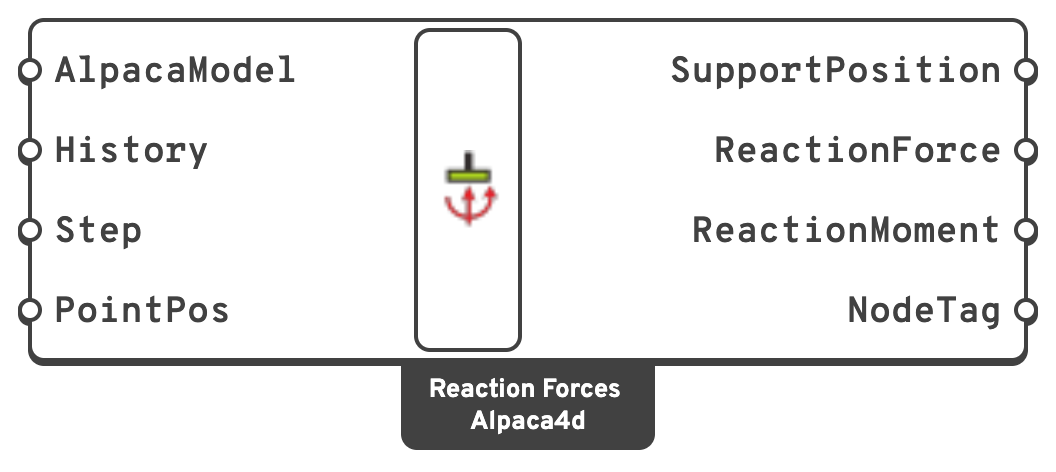
HistoryRead every recorded step instead of one.
{step}; SupportPosition stays a flat list. Step is ignored.PointPosRead only the supports at these points, the same points you gave the Support component.
SupportPositionWhere each support is, and the axes its reactions are given in.
kN, in the support's own axes.kN·m, in the support's own axes.The four lists are parallel: item i of each belongs to the same support. A point in PointPos that no support is at is named in a warning, rather than read as a support carrying nothing.
💡 Why the support's own axes
For a support placed on a Point the plane is world-aligned, so the reactions are the global components — exactly as before.
For a support placed on a Plane, the reactions are resolved onto that plane. This is what makes a released direction read as the zero it actually is: OpenSees reports reactions in global components whatever the support is turned to, which for a skewed support spreads a reaction running along one local axis across all three global ones.
Note
A skewed support carries its restraint on a coincident auxiliary node — see Support — so that is where OpenSees puts the reaction, and the support node itself reads zero. This component reads the right node automatically; you never see the auxiliary node.
📈 When to use it
Use it when
- You need foundation loads to pass on to a footing design.
- You are checking global equilibrium: the sum of the vertical reactions should match the applied load, and if it does not, something in the model is not connected.
- You want to confirm a support is doing what you meant — a released direction should read zero.
💡 Notes
- Reactions are what the support applies to the structure. Sign convention follows the plane's axes.
- Restrained directions of a skewed support are held by a penalty spring, so their reactions are accurate to about one part in 10⁶ rather than exact.