Concrete01
Concrete with zero tensile strength: a parabolic rise to the peak, a linear descent to a crushing plateau, and nothing at all in tension.
🔧 Grasshopper component
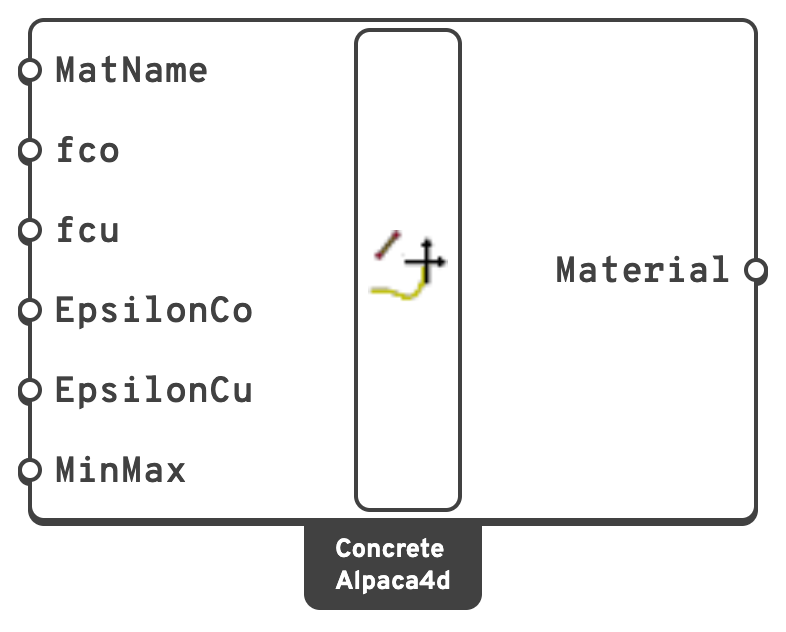
Concrete01 (Alpaca4d) — Alpaca4d ▸ MomentCurvature_βeta, nickname Concrete
Defaults are C25/30.
fcoCompressive strength, in kN/m².
fcuCrushing strength at EpsilonCu — what is left past the peak.
fco.fco. Negative, dimensionless.fcu. Negative, dimensionless.EpsilonCu and zero.Warning
Every stress and strain here is negative. Compression negative is the OpenSees convention for Concrete01, and entering 25000 instead of -25000 gives a section that behaves backwards without any error.
📈 When to use it
Use it when
- You are modelling the concrete part of a reinforced-concrete section.
- You want the cracking and the crushing to come out of the analysis rather than be assumed.
Do not use it when
- You need tensile strength —
Concrete01has none, which is conservative for flexure but wrong for anything relying on tension stiffening. - You need confinement modelled explicitly. You can approximate it by giving the core patch a higher
fcuand a largerEpsilonCuthan the cover.
💡 MinMax
With MinMax on, a fibre that strains past EpsilonCu stops carrying stress permanently, which is what physically happens when concrete crushes. Off, the material follows its curve indefinitely and the moment–curvature curve keeps a residual capacity it should not have.
Turn it on for anything you intend to read a failure point off.
🔗 Relation to OpenSees
uniaxialMaterial Concrete01 $matTag $fpc $epsc0 $fpcu $epscU
uniaxialMaterial MinMax     $wrapTag $matTag -min $minStrain -max $maxStrain
The MinMax wrapper is written only when the MinMax input is true, and the fibres then reference the wrapper's tag.