Put wind on a building
Load the walls of a building with a wind pressure, and its frame with a wind load per metre, as a load case of their own.
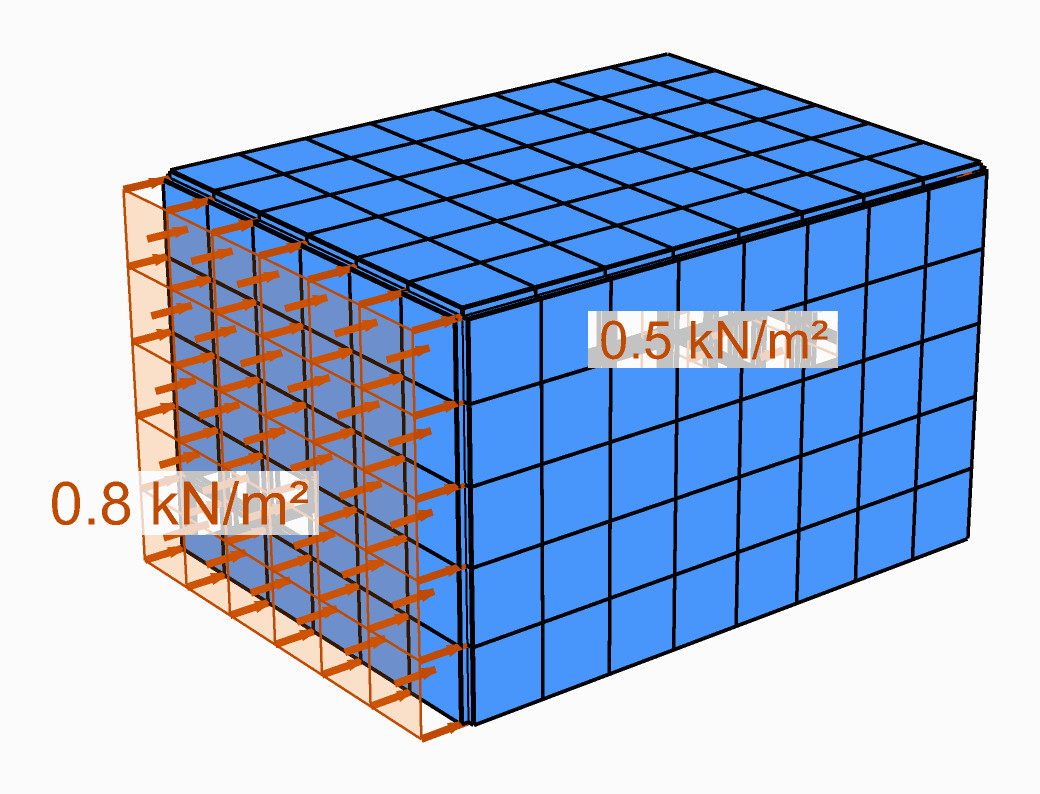
Pressure on the windward wall, suction on the leeward one, both along the wind.
You need
- The walls as ASD Shell elements, each wall's mesh with an ElementId of its own:
Wall_West,Wall_East. - For a frame, its columns as beam elements with an ElementId:
Col_West. - The wind pressure on each face, in
kN/m², worked out to your code of practice: Alpaca4d does not compute it.
Steps
- Place a Mesh Load for each face that takes a different pressure. Type the wall's name into Shell|Id: every face of its mesh is loaded.
- Give Force as a vector in global axes, in
kN/m². Wind blowing along +X pushes the windward wall withq, 0, 0and pulls the leeward one, in suction, also along +X. - For columns or beams in the wind, place a Linear Load with their name in Beam|Id and Force in
kN/m, also in global axes: the pressure times the width each one catches. - Wire all of them into one Load Pattern of its own, the wind case, and the pattern into Assemble's LoadPatterns.
- Set the pattern's Factor for a combination:
1.5for wind as the leading action at the ultimate limit state, say, under the factors your code gives.
Check
- In Model View, tick Show Loads in its Loads menu, and give LoadPattern the wind pattern's Id to draw it alone: the arrows on each wall should point the way the wind pushes or pulls it, and Show Values writes what each is worth.
- Reaction Forces: with the wind case alone, the reactions along X add up to the pressure times the area of the walls, plus the line loads times their lengths.
Good to know
- The pressure is uniform over each Mesh Load and not along each face's normal: it acts in the global direction you give. A sloping roof or a curved wall needs its faces grouped by direction, with a Mesh Load each.
- A name that matches no shell or beam loads nothing, and Assemble warns about it. Two names that match the same element load it twice.
- Every pattern wired into Assemble acts in the same analysis. To see the wind alone, assemble a second model with only the wind pattern.
- The pressure becomes loads on the nodes of each face, its area shared among them, so a coarse mesh carries the same total load as a fine one.
See also
- Load elements by name — naming the elements a load goes on
- Mesh Load — the surface pressure
- Linear Load — loads per metre on beams
- Load Pattern — a load case and its factor
- Barrel Vault, Vertical Truss Facade and Horizontal Truss Facade — examples of wind on a vault and on facades