Interaction Domain
The N–My–Mz resistance domain of a fibre section at the ultimate limit state: every combination of axial force and biaxial bending the section carries before a fibre passes its material's ultimate strain. The same surface as an interaction diagram from RC-SEC or a column-design program, for any section a Fiber Section can describe: reinforced concrete of any shape, steel, or both.
🔧 Grasshopper component
Interaction Domain (Alpaca4d) — Alpaca4d ▸ MomentCurvature_βeta, nickname Interaction Domain
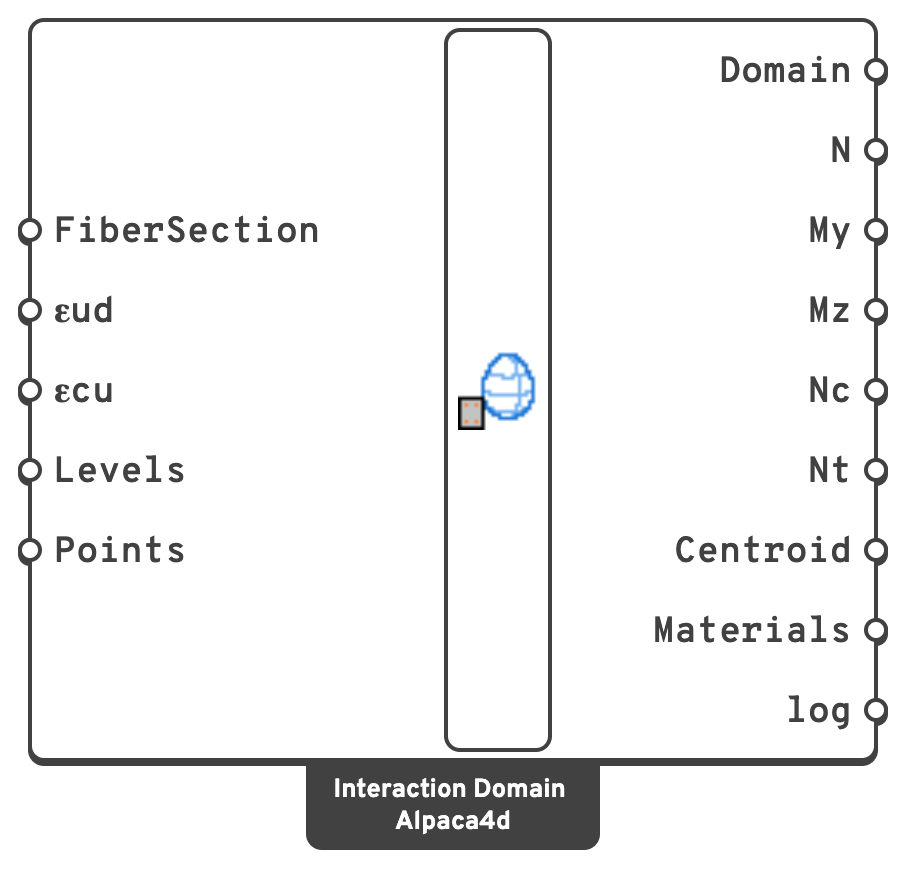
εudUltimate strain, either way, of every fibre that is not Concrete01: reinforcement and structural steel alike.
MinMax bound on the material holds instead where it is tighter. See Steel sections.εcuUltimate compressive strain of the concrete, positive.
EpsilonCu.kN, tension positive: one branch a level, from tension to compression.kN·m.kN·m.kN: negative.kN: zero for plain concrete.CentroidThe point the moments are taken about.
🧮 How the domain is found
The domain is swept over strain planes, not over loads.
OpenSees traces each material's stress–strain curve, once in tension and once in compression, in one short run. Whatever uniaxial material the fibres have is read the way OpenSees reads it.
Every strain plane is scaled to its first limit. A plane — the strain at the centroid and the two curvatures — is grown until the first fibre reaches its ultimate strain:
Material Held to Concrete01 εcuat its most compressed point; and, when the concrete is all in compression,εc2(itsEpsilonCo) at point C, (1 − εc2/εcu) of the depth from the most compressed edge — the pivots of Eurocode 2, 6.1 and Figure 6.1. No limit in tension.everything else ±εud, or itsMinMaxbounds where those are tighter.The fibres are integrated on that plane, which gives one point (N, My, Mz) of the boundary. Planes in every direction give the whole surface: pure tension at the bottom, pure compression at the top.
Nothing has to converge, so the method does not fail near the axial capacity the way a moment–curvature analysis with a held axial force does. Each point is a ULS state under proportional loading — every fibre strained monotonically from zero — which is what a resistance domain assumes.
A patch is held to its limits at the vertices of its mesh, which reach its outline; a point fibre or a layer's fibre is a bar, and is held where it is. Checked at the patch's fibres instead, half a fibre inside the edge, an HEA 300's elastic moment came out 1 % high.
💡 Eurocode 2 domains
Concrete01 with its crushing strength equal to its peak — fcu = fco — is exactly Eurocode 2's parabola–rectangle (n = 2), and Steel01 with no hardening — b = 0 — is elastic–perfectly plastic. With design strengths that is the domain of EN 1992-1-1, 6.1:
| Material | Inputs, C30/37 and B500, in kN/m² |
|---|---|
| Concrete01 | fco = -17000 (0.85 × 30 / 1.5 MPa), fcu = -17000, EpsilonCo = -0.002, EpsilonCu = -0.0035 |
| Steel01 | fy = 434783 (500 / 1.15 MPa), E0 = 200000000, b = 0 |
and εud = 0.01, or 0.9 εuk for an inclined branch. A material from the library with its characteristic strengths gives a characteristic domain, not a design one.
🔩 Steel sections
A section of steel only has no concrete limit to reach, so εud decides which resistance the domain is:
| εud | Domain | Checked against EN 1993-1-1 on an HEA 300 |
|---|---|---|
large, e.g. 0.05 | plastic — Class 1 and 2 | N = A fy, My = Wpl,y fy exactly; Mz within 0.4 % under Wpl,z fy, as the web sits in the elastic core |
fy / E | elastic — Class 3, first yield | Wel,y fy and Wel,z fy exactly, and N/Npl + My/Mel,y + Mz/Mel,z = 1 round every level |
The plastic domain is the exact one, so it differs from the formulas of 6.2.9.1 where those approximate: with a little axial force they keep Mpl,y, while the web gives up its share of it at once, M = Mpl,y − N²/(4 tw fy). Draw the section's outline with its root fillets: an HEA 300 without them has 5.6 % less area.
Local buckling (Class 4), shear and member buckling are not part of a section's domain.
Moments about the centroid
Moments are about the area centroid of every fibre, steel included, which is the point OpenSees' fibre section takes them about, so they match Moment Curvature's. For a section with unsymmetric reinforcement this is not the concrete's centroid, and pure compression comes with a small moment about it. Design forces given to Domain Check have to be about the same point.