❄️ 3. Snowy roof
A rafter carrying snow along its length and its own weight, and how deep it must be.
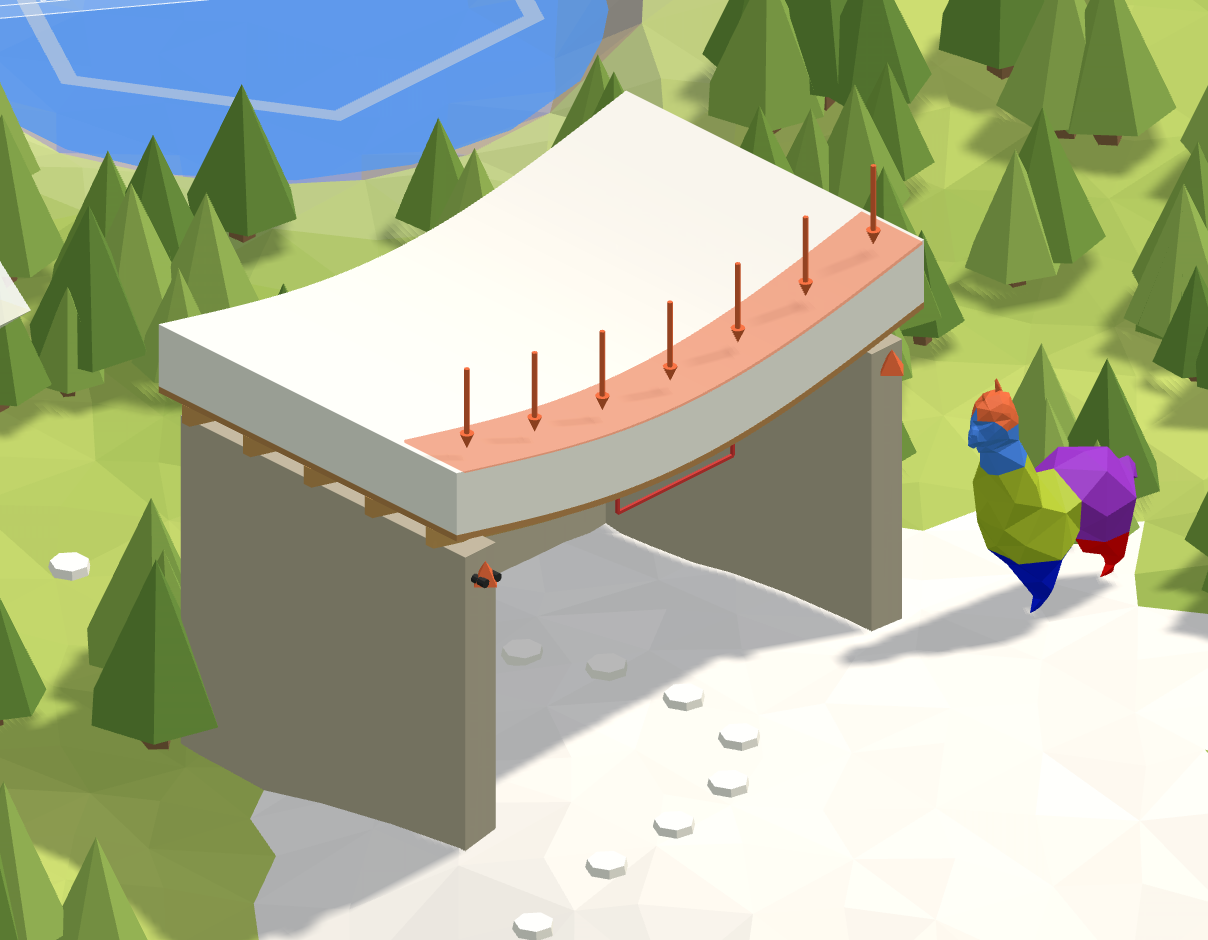
A rafter under snow. A timber rafter of a flat roof, carrying the snow along its length and its own weight. How deep must it be to sag no more than L/250?
GHroof-start.ghGrasshopper file · download
GHroof.ghGrasshopper file · download
Start from roof-start: the rafter is there as the River left off, 100 mm deep, and the steps below load it and size it. roof is the finished definition. The same rafter is the third area of the Playground, where you build it a piece at a time by picking the right Grasshopper snippet, and see what each wrong one would build.
What you will learn
- A load along a beam, in kN per metre, from a load on a roof in kN per square metre.
- The beam's own weight, from Gravity Load, and both loads in one Load Pattern.
- Twice as deep is eight times as stiff; checking a sag against L/250.
The rafter
A flat roof of C24 rafters, 75 mm wide, spans 4 m from Wall A to Wall B, on a pin and a roller. The rafters are 0.6 m apart, and 1.5 kN of snow lies on every square metre of the roof. Alpaca4d works in metres and kilonewtons (Units).
Steps
- The rafter. Open roof-start. The rafter's line runs 4 m along X, cut into four elements by Divide Curve and Shatter, with a pin at Wall A and a roller at Wall B, as on the River. Its section is a RectangleCS, Width 0.075 and Depth 0.1 into Height: on a horizontal beam Height points up, so the rafter stands on its edge.
- The snow. Each rafter holds up a strip of roof 0.6 m wide, so it carries 1.5 × 0.6 = 0.9 kN on every metre of its length. A Multiplication of Snow, −1.5, and Spacing, 0.6, into Unit Z makes the force, 0.9 kN down. Wire it into the Force of a Linear Load, and leave its Beam|Id empty: the load goes on every beam, the rafter's four elements.
- Its own weight. A Gravity Load weighs every element from its section and its material's density, 410 kg/m³ for C24, and pulls it down. Leave its Factor at 1, the true weight.
- The load pattern. Wire both loads into the Loads of a Load Pattern: hold Shift as you wire the second, or it replaces the first. Its TimeSeries left empty, the loads act at full size.
- Run. The rafter, both supports and the Load Pattern into Assemble Model, then Run Analysis with an Analysis Settings as it comes, and its AlpacaModel into Model View, with Deformed ticked and a Deformation scale of 20. The rafter sags 47 mm: three times L/250 = 4000 / 250 = 16 mm.
- How deep. Move Depth to 0.15. The rafter sags 14.3 mm, under 16 mm.
Check it by hand
A simply supported beam under a uniform load w sags in the middle by
The load is the snow and the rafter's weight, w = 0.9 + 0.075 × 0.15 × 410 × 9.81 / 1000 = 0.945 kN/m, and with L = 4 m, E = 10 500 MPa and I = bh³/12 = 0.075 × 0.15³ / 12 = 2.11 × 10⁻⁵ m⁴:
OpenSees gives 14.3 mm. The beam's shear adds the twentieth of a millimetre.
Try
- Twice as deep: Depth 0.2 sags 6.1 mm, about an eighth of the 47 mm at 0.1, because I grows with the cube of the depth. Twice as wide, Width 0.15 with Depth 0.1, sags 24.4 mm: only twice as stiff, for the same timber.
- More snow: a mountain roof can carry 3 kN/m². Find the depth it needs.
- Wider apart: Spacing 1.2 doubles each rafter's snow. Fewer, deeper rafters or more, shallower ones?
The usual mistakes
| You see | Why | Fix |
|---|---|---|
| The rafter sags two thirds more than it should | 1.5 kN/m² wired straight into Linear Load, which reads kN per metre of beam. | Multiply by the spacing: 1.5 × 0.6 = 0.9 kN/m. |
| The rafter sags four times as much, or breaks | The snow on the whole rafter, 3.6 kN, given as its Force: Linear Load puts it on every metre. | Its Force is per metre: 0.9. |
| The roof bends up | +0.9 into Unit Z: Z points up. | A weight is negative: −0.9. |
| The rafter ten times as heavy | Gravity Load's Factor set to 9.81: it already multiplies the mass by g. | Leave Factor at 1. |
| Unsupported item at LoadPatterns input: LineLoad | A load wired straight into Assemble Model's LoadPatterns. | Put the loads in a Load Pattern first. |
| 0.0 mm, and no message | Nothing in Assemble Model's LoadPatterns: the model solves with no loads. | Wire the Load Pattern in. |
| A few percent too little sag, and no message | Algorithm Linear in Analysis Settings: one solve, and a ForceBeamColumn takes in the bending of a load along it only as it iterates. | Leave Algorithm at Newton. |
The components
- Linear Load · Gravity Load · Load Pattern · Rectangular · Material Library Elastic · ForceBeamColumn · Support · Assemble · Analysis Settings · Run Analysis · Model View