
Linear Buckling Analysis
Finds the load factors at which the structure buckles under its loads, lowest first, and the shapes it buckles into. The first factor is the critical load factor
🔧 Grasshopper component
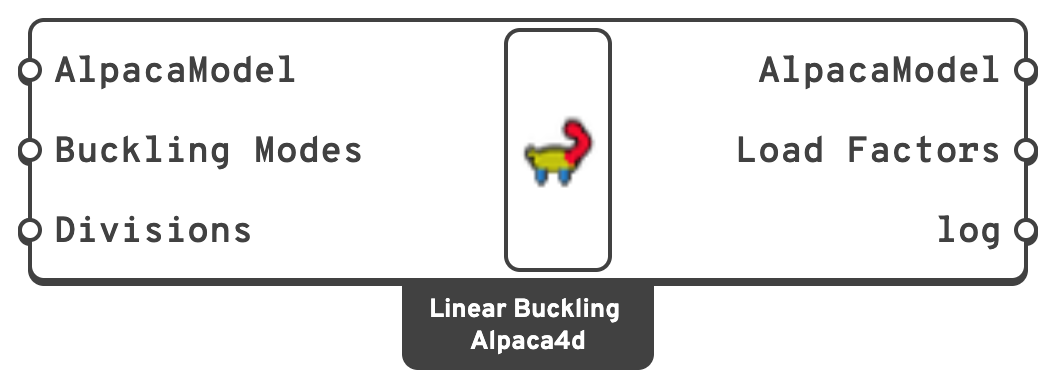
AlpacaModelThe assembled model, from Assemble, with the loads to buckle it under, or an analysed one, from Run Analysis, Section Optimiser or Natural Vibration.
DivisionsHow many elements every beam is split into for the analysis.
1 leaves them whole. See Divisions.AlpacaModelThe buckled model. Its steps are the buckling modes, step 0 the first, each scaled to a largest translation of 1.
Load FactorsOne per mode, lowest first: what the loads are multiplied by for the model to buckle.
Like Natural Vibration, it needs no Analysis Settings: it sets up and runs its own analysis.
🧮 What it solves
The loads are those of the assembled model at load factor 1, as one step of Run Analysis applies them: every load pattern, with its factor. Ground motion patterns are left out, since they load nothing in a static step.
The analysis is linear: elastic, about the undeformed shape, with the axial and membrane forces of a first-order analysis under those loads. The load factors
where
OpenSees has no buckling analysis, but it can print its stiffness matrix. With no load the matrix is
For the analysis, and only for it (the model connected is not changed):
- Every beam gets a PDelta transformation, which is what gives a beam its geometric stiffness.
- Shells keep their type but run linear, and Alpaca4d adds their geometric stiffness from the membrane forces OpenSees finds under the loads, for buckling out of their plane and in it. No shell of OpenSees has all of it: the corotational ASD shells leave it out, and ShellNLDKGQ / ShellNLDKGT keep only the part out of their plane, so the web of a box column, swaying in its own plane, would never soften.
- Beams are split as Divisions asks.
- Solids, SSP Brick and Ten Node Tetrahedron, run as they are, and Alpaca4d adds their geometric stiffness from the stresses OpenSees finds in them under the loads,
for each pair of nodes. No solid of OpenSees has one: they are small-strain elements. It is taken where the element takes its own stiffness: at the centre of an SSP Brick, which is stiffened against hourglassing rather than integrated at eight points, and at the four points of a ten node tetrahedron. A column of bricks buckles within 0.3 % of Euler's load, and under its own weight within 0.3 % of Greenhill's. - A joint band - a thin band of solids standing in for springs spread over a horizontal joint, its material an Elastic Orthotropic marked as a surface connection, as the printed cylinder example's joints are - gets the geometric stiffness of a joint, not of a band. A band t thick under a pressure
would also soften against slip by , which springs of no thickness never do, and buckle in shear at ; so the slip across it is left out, and a stack of layers on slipping joints buckles at Haringx's load, as a laminated rubber bearing does.
Two solid examples, fresh concrete stiffening with age, checked for buckling as it is printed: the 3D printed cylinder and a 3D printed structure, a branching shell printed along its own sections.
✂️ Divisions
A PDelta beam only feels the sway of its chord, the line between its ends. That is all the sway of a frame needs, so a frame can be left as it is. A member that buckles on its own, bowing between its ends, needs to be split into several elements.
With n elements to a half wave of the buckled shape, the load factor comes out about 85 % / n² too high:
| Divisions | Load factor of a member buckling on its own |
|---|---|
1 | None: a member pinned at both ends has no node in between to buckle at. |
4 | About 5 % too high |
8 | About 1.3 % too high |
16 | About 0.3 % too high |
Twice the elements give a quarter of the error. A member fixed at both ends buckles in one half wave over half its length, so it needs twice as many elements as a pinned one for the same accuracy.
⚠️ Limits
- Beams buckle in bending only. Lateral-torsional and torsional buckling need warping, which the beam elements do not have. Check lateral-torsional buckling of members with Utilisation.
- It is linear. It leaves out imperfections, plasticity and the deformation before buckling, so
is the elastic critical load factor, not the load the structure can carry. - Model size. OpenSees 3.8.0 can only hand the stiffness matrices over as full tables, which limits the model to 4000 equations, about 650 beam or shell nodes. A build of OpenSees newer than 3.8.0 hands them over sparse, with no such limit: a plate of 39 000 equations takes a little over a minute, a printed cylinder of 15 000 equations in bricks about 15 seconds. Choose the OpenSees that runs in Alpaca4d → Settings → Set OpenSees Executable... (see Setup).
📋 What it reports
| Message | Means |
|---|---|
| The first load factor is …: the model buckles before its loads are reached. | |
| Nothing buckles under these loads | No member is compressed by the loads. |
| The beams are not split | Divisions is 1: right for the sway of a frame, not for a member buckling on its own. |
| … beam transformations were made PDelta | What was changed for the analysis. |
| OpenSees could not solve the model with no load | The model is a mechanism, or a support is missing. |
| The model has … equations | Too many for this OpenSees; see Limits. |
| This AlpacaModel has been analysed, and does not carry the model it was analysed from | It was analysed by something other than Run Analysis, Natural Vibration, Linear Buckling or Section Optimiser. Connect the output of Assemble. |
📈 When to use it
Use it when
- You check whether a frame needs a second-order analysis. EN 1993-1-1 5.2.1 lets a first-order analysis stand when
for an elastic analysis (15 for a plastic one). Below that, the second-order effects of sway have to be accounted for. - You need the buckling length of a member for a design check. With
its axial force under the loads, it buckles at , so . Give it to Utilisation's LengthY or LengthZ. - You want to see how a structure, a compressed plate or a shell, will lose stability, and which of its parts goes first.
Do not use it when
- You want the load a real, imperfect structure collapses at → a non-linear static analysis with Run Analysis, with imperfections modelled.
- You want the lateral-torsional buckling of beams → Utilisation.
Note
The licence works as for Run Analysis: models up to 50 elements run without one, and the design a topology optimisation finds up to 500.
🔗 Relation to OpenSees
The component writes one deck and runs it in OpenSees. The model comes first, with its beams made PDelta and its shells linear, then:
system FullGeneral          ;# OpenSees 3.8.0; a newer one prints sparse, see below
constraints Transformation
numberer AMD
test FixedNumIter 1 0
algorithm Newton
integrator LoadControl 0.0
analysis Static
analyze 1                   ;# no load
printA ...                  ;# K
pattern Plain ...           ;# the model's load patterns
integrator LoadControl 1.0
analyze 1                   ;# the loads, at factor 1
printA ...                  ;# K - K_G of the beams
eleResponse $shell stresses ;# the membrane forces of each shell
wipe
An OpenSees newer than 3.8.0 prints the matrices sparse. It solves the two steps with Mumps, on every core, when it has it (see Setup), and with SuperLU when it has not, or when Mumps fails. Mumps keeps its matrix to itself, so for each printA the deck puts SuperLU's system in its place, which only assembles the matrix, and Mumps back after:
if {[catch {system Mumps -matrixType 1 -numThreads 0}]} { system SparseGeneral }
...
system SparseGeneral; initialize       ;# when Mumps solves
printA -file K.mtx -sparse 1 -precision 16
system Mumps -matrixType 1 -numThreads 0
numberer AMD numbers the equations to keep the factor small. SuperLU factorises them in the order they are numbered, so with numberer Plain the time depended on the order of the nodes: an arch of bricks of 20 000 equations took 3 minutes numbered along its length, 10 numbered at random, and half a second with AMD.
A model with no beams or trusses, of solids and shells alone, needs one print. OpenSees gives neither a geometric stiffness, so K - K_G under the loads would be K again: the deck prints K before the loads, without a step, as printA forms it itself, and solves only the step to the loads, for the stresses.
initialize                  ;# no step: printA forms K
printA ...                  ;# K
pattern Plain ...           ;# the model's load patterns
integrator LoadControl 1.0
analyze 1                   ;# the loads, at factor 1
eleResponse $solid stresses ;# the stresses of each solid
Alpaca4d adds the geometric stiffness of the shells, built from their membrane forces, and solves the eigenvalue problem. The buckled shapes are written to recorder_buckling_<id>_0.mpco, in the AlpacaResults folder next to the Grasshopper file, where <id> is the start of the component's InstanceGuid: each Linear Buckling keeps a file of its own. A model whose ties are chained, such as a rigid link from a node of a rigid diaphragm, runs on the Penalty constraint handler, since Transformation gets chains wrong; so does a model with a shell on a tied node.