Damping
Rayleigh damping: a damping matrix built as a linear combination of the mass and stiffness matrices,
🔧 Grasshopper component
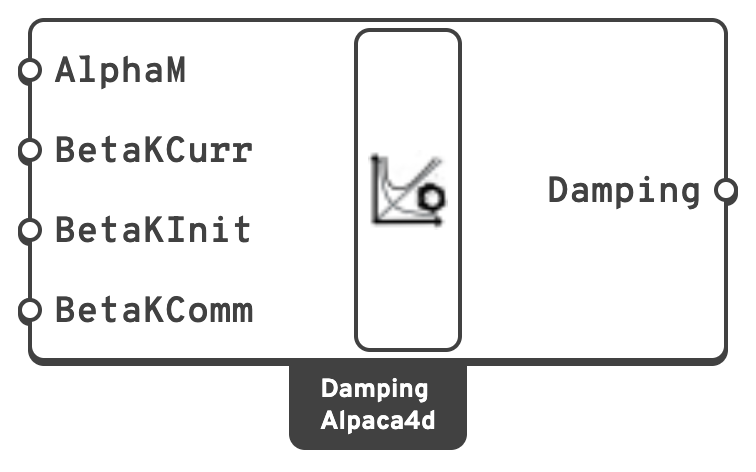
AlphaMFactor on the mass matrix.
Use exactly one of the three stiffness terms. They damp the high frequencies.
💡 Picking the coefficients
Target a damping ratio
Get the frequencies from Natural Vibration first — usually the first mode and whichever higher mode still carries meaningful mass. Between the two the damping ratio dips slightly below
With both frequencies the same,
Which stiffness matrix to use:
| Term | Behaviour |
|---|---|
BetaKInit | Damping stays tied to the elastic stiffness. Predictable, but can over-damp a structure that has softened a lot. |
BetaKCurr | Damping follows the tangent stiffness, and falls away as the structure yields. |
BetaKComm | Uses the last committed stiffness — a middle course, and the usual recommendation for non-linear work. |
📈 When to use it
Use it when you are running a Transient analysis. Without damping a dynamic model rings indefinitely, and the peak response is overestimated.
Do not use it when the analysis is static — the damping matrix is never formed, and the input is ignored.
🔗 Relation to OpenSees
rayleigh $alphaM $betaKcurr $betaKinit $betaKcomm