ReinforcingSteel
A reinforcing bar material: elastic to yield, a yield plateau, then a curved strain-hardening branch up to the ultimate strength.
🔧 Grasshopper component
ReinforcingSteelAlpaca4d ▸ MomentCurvature_βeta
Inputs
Defaults are B450C.
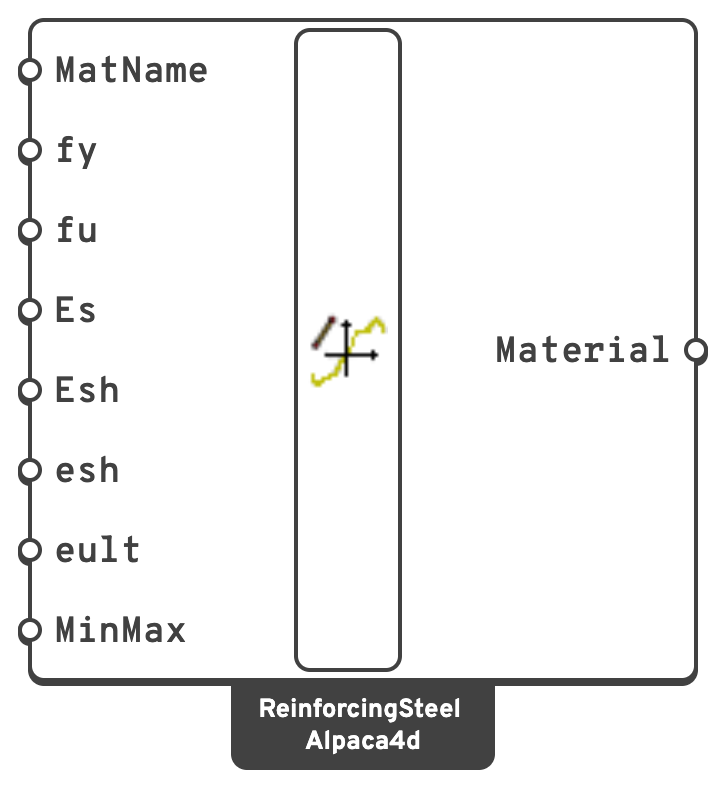
MatNameMaterial NameLabel for the material.
fyYield strength, in
kN/m².fuUltimate strength, in
kN/m².EsInitial elastic modulus, in
kN/m².EshTangent modulus at the onset of strain hardening, in kN/m².
Must be greater than zero.
eshStrain at the onset of strain hardening.
Must be past the yield strain
fy/Es.eultStrain at
fu.MinMaxWrap the material so a bar fails once its strain passes
eult in either direction.Outputs
MaterialUniaxial material, for a Layer, Fiber Point or Patch.
This is the default material for Fiber Point and Layer Fiber — leave their Material input empty and they use B450C.
📈 When to use it
Use it when
- The fibres are reinforcing bars. The yield plateau and the curved hardening branch are what distinguish a bar from a structural steel section, and they set where the moment–curvature curve flattens.
Do not use it when
- The fibre is structural steel → Steel01 is simpler and more appropriate.
💡 MinMax
With MinMax on, a bar that strains past eult stops carrying stress — bar rupture. This is what puts an honest end on a moment–curvature curve; without it the section keeps resisting after its reinforcement should have broken.
Turn it on, together with Concrete01's, for any curve you intend to read a failure point off.
🔗 Relation to OpenSees
tcl
uniaxialMaterial ReinforcingSteel $matTag $fy $fu $Es $Esh $esh $eult
uniaxialMaterial MinMax           $wrapTag $matTag -min $minStrain -max $maxStrain