🧗 2. Cliff
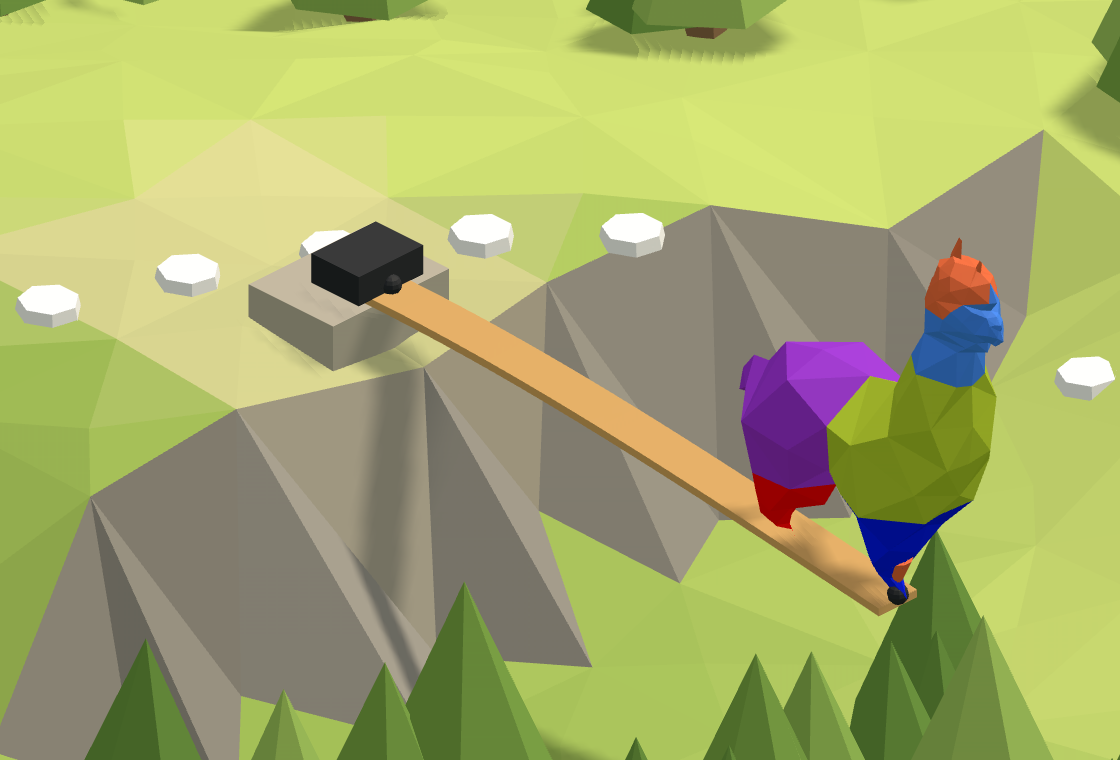
The River's plank built into a cliff and sticking out over the drop: a cantilever balcony, with the alpaca at its tip.
A balcony over the drop. The River's plank, built into the cliff at one end and free over the drop at the other, with the alpaca standing at its tip. How far does the tip go down?
GHcliff-start.ghGrasshopper file · download
GHcliff.ghGrasshopper file · download
Start from cliff-start: the balcony's line, section and beam are there, and the steps below add the rest. cliff is the finished definition. The same balcony is the second area of the Playground, where you build it a piece at a time by picking the right Grasshopper snippet, and see what each wrong one would build.
What you will learn
- What a fixed support holds, and why a cantilever needs one.
- Reading a displacement as a number with Nodal Displacements.
- Why the same span and load bend a cantilever 16 times as much as a plank held at both ends.
The balcony
The plank of the River, C24 timber 300 mm wide and 50 mm thick lying flat, is built into the cliff at its edge and sticks out 4 m over the drop. The alpaca, 0.6 kN, walks out to its tip for the view. Alpaca4d works in metres and kilonewtons (Units).
Steps
- The balcony. Open cliff-start. The Root is at the origin, at the cliff's edge, and the Tip at X = 4, from the Span slider: the balcony runs along X, out over the drop. The section is the River's, and a ForceBeamColumn, Balcony, makes one element of the line. One is enough: a beam's ends are its nodes, and the alpaca will stand on the Tip's.
- The support. A Support, its Position at the Root, with nothing wired into Tx to Rz. Every input of a Support left empty holds that way, so it holds all six: the Root can neither move nor turn. That is a fixed support. Held at one end only, a cantilever needs it: the River's pin would let it swing down.
- The alpaca. End Points of the line gives its start, S, and its end, E: the Tip. Unit Z with a factor of −0.6 makes the force, 0.6 kN downwards. Wire E into Point and the vector into Force of a Point Load, and the load into a Load Pattern.
- Assemble. Into Assemble Model: the beam's Element into Elements, the support into Supports, the Load Pattern into LoadPatterns.
- Run and read. An Analysis Settings as it comes into the Settings of Run Analysis, and its AlpacaModel into Model View, with Deformed ticked and a Deformation scale of 1: true to scale. Then into Nodal Displacements: its Displacement lists how far each node moved, in metres, in the order Assemble Model numbered them, the Root then the Tip. Deconstruct Vector splits each into X, Y and Z: the panel Z in m shows 0 for the Root and −0.390 for the Tip.
Check it by hand
A cantilever with a point load P at its tip goes down there by
with L = 4 m, E = 10 500 MPa for C24 and I = bh³/12 = 0.3 × 0.05³ / 12 = 3.125 × 10⁻⁶ m⁴:
OpenSees gives 390 mm too; the beam's shear adds 0.05 mm. On two supports with the load in the middle, the River, it is PL³ / 48EI = 24.4 mm: held at one end only, the same plank, span and load bend 48 / 3 = 16 times as much.
Try
- Make it a balcony you would stand on: 390 mm is far too much. Stand the plank on its edge, swapping Plank width and Plank thickness: I grows 36 times, and the tip goes down 10.8 mm.
- Halve the span: Span 2. The tip goes down 2³ = 8 times less, 49 mm: a cantilever's bend grows with the cube of its length.
- Free the Root about Y: a Boolean Toggle set to False into the Support's Ry. Run Analysis fails: nothing stops the balcony turning.
The usual mistakes
| You see | Why | Fix |
|---|---|---|
| Analysis Failed: OpenSees 'analyze' did not converge. | The support lets the Root turn, as the River's pin does: with one support only, the balcony is a mechanism. | Leave Tx to Rz empty, so that the Support holds all six. |
| The tip goes down 0 mm | The Support stands at the Tip, holding it in thin air, or the load is at the Root, on the support. | Support at the Root; the load at End Points' E. |
| Input parameter Force failed to collect data | The weight went into Point Load's Moment, and Force is empty. | Wire the vector into Force. |
| The model is not analysed. | Nodal Displacements is fed from Assemble Model: there are no results to read yet. | Feed it Run Analysis's AlpacaModel. |
| 0 and 0 in the panel | Deconstruct Vector's X into the panel: the tip goes down, not along the balcony. | Read Z. |
| The balcony lies on the cliff top | Span into the Tip's Y, or a negative Span. | +4 into the Tip's X: X points out over the drop. |
The components
- Material Library Elastic · Rectangular · ForceBeamColumn · Support · Point Load · Load Pattern · Assemble · Analysis Settings · Run Analysis · Model View · Nodal Displacements
See also
- 🌊 1. River: the same plank on two supports
- Hold a node with a support
- Axes and signs
- Steel Cantilever