Rigid Diaphragm
A rigid diaphragm makes a group of nodes move as if connected by an infinitely stiff in-plane plate. It is how you model a floor or roof slab that is far stiffer in its own plane than the columns and walls around it.
🔧 Grasshopper component
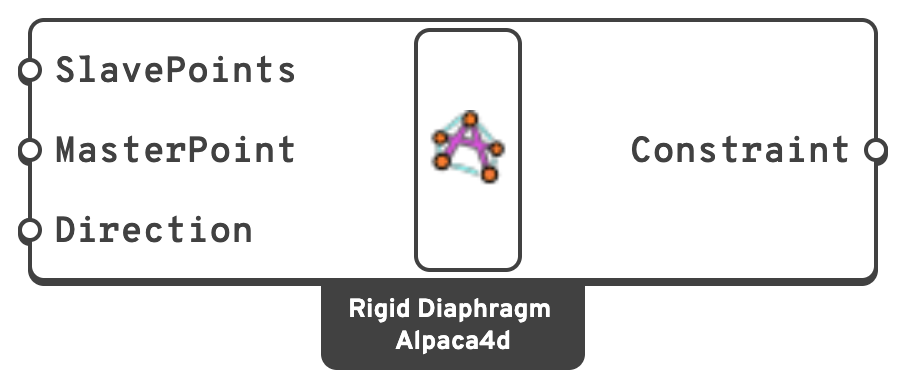
1 → yz plane, 2 → xz plane, 3 → xy plane.📈 When to use it
Use it when
- You are modelling a reinforced-concrete slab or a composite deck as a stiff floor plate, one diaphragm per storey.
- You want the lateral response of a building governed by the vertical elements, without meshing every floor as shells.
Do not use it when
- The floor is genuinely flexible in plane — a timber deck, a slab with a large opening. Model it with Shell elements instead.
- You only need two nodes tied together → use Rigid Link or Equal DOF.
💡 Notes
- The slave points must be roughly coplanar. The component warns you if they are not.
- The Direction must match the plane the points actually lie in — a floor slab in plan is
3. - Diaphragms dominate the global lateral behaviour. Check the direction before reading any storey drift.
Every floor of a tall building is one. The towers of a hundred storeys and more shaken by El Centro - the Bundled Tube, Braced Tube, Buttressed Core, Outriggers and a Damper and Diagrid examples - give SlavePoints a tree, each floor's nodes on a branch of its own, and MasterPoint one of each floor's nodes on the same branches: one Rigid Diaphragm makes a diaphragm a floor. Their floors' mass is given as Mass Points at the floors' nodes, which the diaphragms then carry together.
🔗 Relation to OpenSees
rigidDiaphragm $dir $masterNodeTag $slaveNodeTag1 $slaveNodeTag2 ...Node tags are resolved from the point coordinates by the Assemble tolerance.