Steel01
Bilinear steel with kinematic hardening: elastic to yield, then a straight strain-hardening branch.
🔧 Grasshopper component
Steel01Alpaca4d ▸ MomentCurvature_βeta
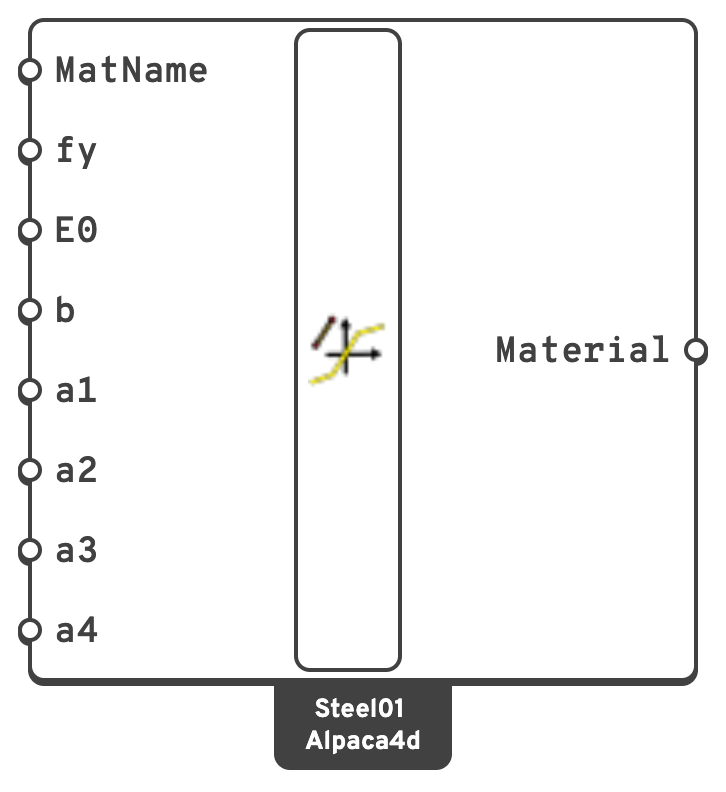
Inputs
Defaults are S355.
MatNameMaterial NameLabel for the material.
fyYield strength, in
kN/m².E0Initial elastic modulus, in
kN/m².bStrain-hardening ratio: the post-yield tangent divided by
E0.a1Isotropic hardening in compression.
a2Compression hardening limit.
a3Isotropic hardening in tension.
a4Tension hardening limit.
Warning
a1 to a4 are one optional group of four. Give all four or leave all four empty — a partly filled set is an error, not a silent default.
Outputs
MaterialUniaxial material, for a Patch, Layer or Fiber Point.
📈 When to use it
Use it when
- You are modelling structural steel in a fibre section — a steel beam, a composite section, an embedded plate.
- A bilinear idealisation is enough, which for structural steel it usually is.
Do not use it when
- The fibre is a reinforcing bar → ReinforcingSteel models the yield plateau and the curved hardening branch that bars actually have.
- You need the rounded Bauschinger transition of a cyclic response —
Steel01has a sharp corner.Steel02would, but is not exposed.
🔗 Relation to OpenSees
tcl
uniaxialMaterial Steel01 $matTag $Fy $E0 $b <$a1 $a2 $a3 $a4>