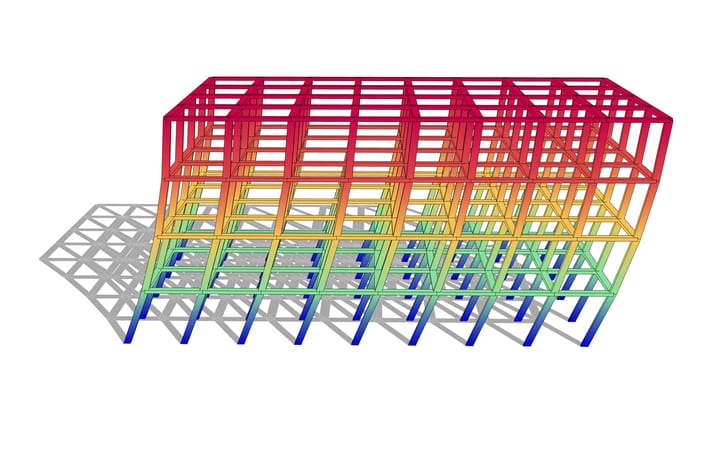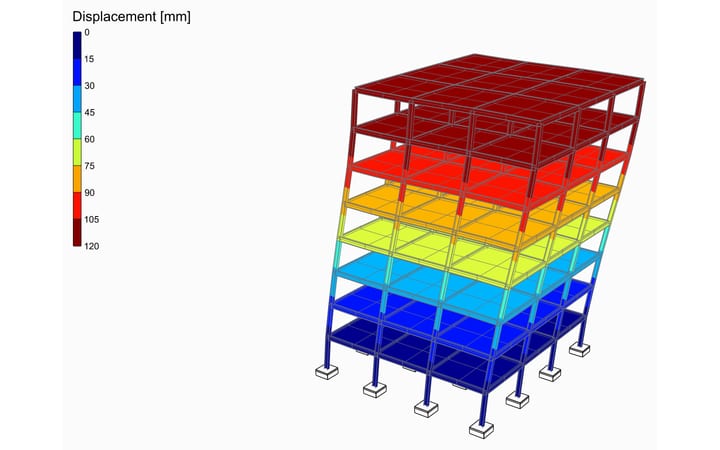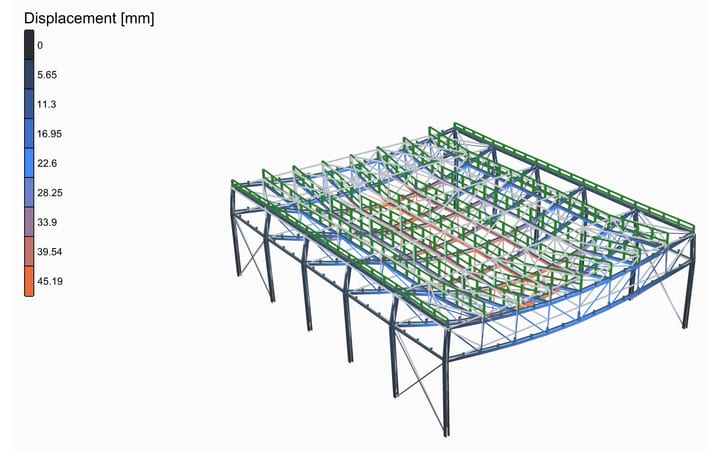
A 4 m steel cantilever, built in at its root, carrying its own weight and 15 kN at its tip, checked to EN 1993-1-1 with Utilisation. It shows how to set up a member so that Utilisation can check it, what a cantilever needs that a beam held at both ends does not, and how to read the result.
INFO
The example needs a version of Alpaca4d whose Utilisation has the LengthLT input, for lateral-torsional buckling.
The model
| Group | What it does |
|---|---|
| 1 - The cantilever | Length, Tip load, Section and Grade: the four things to try. |
| 2 - Geometry | A line along X, from the root at the origin to the tip. |
| 3 - Member | Material Library Elastic makes S355, and stamps the grade on the material: that is how Utilisation knows the beam is steel, and its fy. Steel Section Library gives the HEA 200. The Force Beam Column has no ZAxis, so its local y points up: the depth of the I is vertical, and the tip load bends it about its major axis. |
| 4 - Support and loads | Built in at the root, all six restrained. A Point Load at the tip and Gravity, in one Load Pattern. |
| 5 - Analysis | Run Analysis with the default settings: one step, to the full load. |
| 6 - Utilisation | The check, and panels for what it gives. |
Using Utilisation
- AlpacaModel comes from Run Analysis, not from Assemble Model: the check reads the forces the analysis recorded. Step is left at 0, the one step.
- LengthY, LengthZ and LengthLT are each twice the length, from an Expression
f(L)=2*L. Left empty, each would be the beam's own length, held at both ends - and a cantilever's tip is not held at all. 2 L is the flexural buckling length of a cantilever. For lateral-torsional buckling, a LengthLT longer than the beam stands for an effective length, with the root moment taken as uniform over all of it: on the safe side for a root built in sideways and against twist. - The Design menu below the component is open. Its Report input is on, and its Governing and Class outputs are wired to panels.
- Max is the largest of the checks, and Governing says which one gives it. Report has every number on the way, to follow the check by hand.
WARNING
The lengths are yours to give. Utilisation cannot know how a member is held. A cantilever, a sway column or a member drawn as several beams needs its lengths given; see the Utilisation page.
What it shows
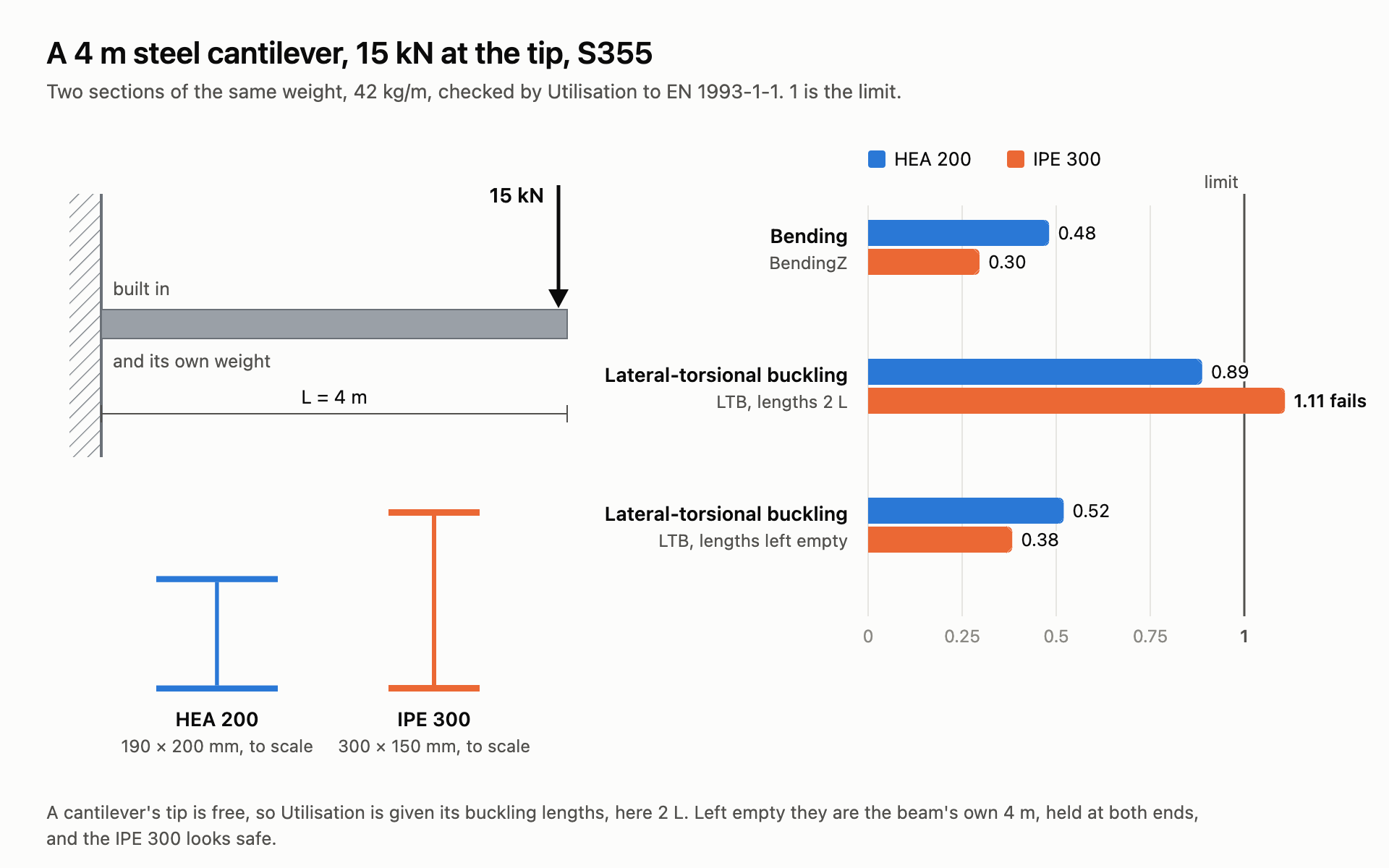
The HEA 200 and the IPE 300 weigh the same, 42 kg/m. Switch Section to compare them:
| Section | Bending (BendingZ) | LTB, lengths 2 L | LTB, lengths left empty | Max |
|---|---|---|---|---|
| HEA 200 | 0.48 | 0.89 | 0.52 | 0.89, LTB |
| IPE 300 | 0.30 | 1.11 | 0.38 | 1.11, LTB |
| HEA 240 | 0.28 | 0.46 | 0.28 | 0.46, LTB |
The IPE 300 is the deeper section and the stronger in bending, but its narrow flanges let it buckle sideways: it fails. Left with its lengths empty, it would have read 0.38 and passed.
The Report for the HEA 200 ends:
LTB        0.888  L_LT = 8, longer than the member (4): its peak moment taken as uniform over all of it,
           fork supports: M_Ed = 63.145, M_cr = 81.88, λ̄LT = 1.266, curve b (α = 0.34),
           6.3.2.3 (λ̄LT,0 = 0.4, β = 0.75, f = 1), χLT = 0.542, M_b,Rd = 71.115 with W_el
Max 0.888, from LTB
M_Ed is the tip load and half the beam's weight times the 4 m arm: (15 + 0.79) × 4 = 63.1 kNm. The section is Class 3 - its flanges, with no root radius - so the resistance uses W_el.
Try Length, Tip load and Grade too, and watch which check governs.