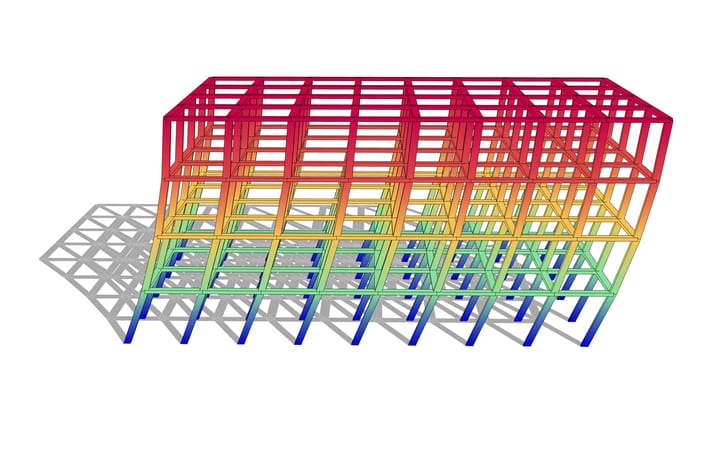
A tube of steel diagonals round a concrete core, a tube in a tube: 103 storeys, 440 m tall. The diagonals cross each other every 12 storeys, twelve diamonds round the tower, and pass through every floor, where a ring beam meets them; they carry both the weight and the sway, as a lattice. Its plan is a triangle with rounded corners, bulging half way up. This is the structure of the Guangzhou International Finance Center. The El Centro earthquake shakes the ground along x.
The first 31 s of El Centro, as they happened, the movement drawn larger than it is. Beside it, the ground's acceleration and the movement along x of the edge of the roof, over the same 31 s.
The model
| Group | What it does |
|---|---|
| 1 - Geometry | The sliders - Radius, Bulge half way up, Diamonds round it, Storeys, Storey height, Storeys a diamond and Core - and a Python component that draws the tower from them: the diagonals floor by floor, the ring beams, the core's walls as a mesh a storey; the feet; each floor's nodes and the one it is driven from, for the diaphragms; each node's share of its floor's mass; and the edge of the roof the charts follow. |
| 2 - Members | S355 from Material Library; the diagonals tubes 1.8 m across, a CircleCS 180 mm thick, which stands for a thinner tube filled with concrete; HEM1000 ring beams from Steel Section Library; all as ForceBeamColumn. The core's walls 1 m of concrete, a Plate Fiber Section, as ASD Shells. |
| 3 - Supports and floors | Every column and wall built in at the ground, with a Support; and every floor a Rigid Diaphragm - its nodes move together in its plane, as a concrete floor makes them - driven from one of its nodes. |
| 4 - Ground motion and masses | The El Centro record, as in the other earthquakes, along x. A Mass Point at every node of every floor: Floor mass kg/m² of the floor's area - its slab, finishes, facade and some of what is in it - shared between its nodes. |
| 5 - Transient analysis | Assemble, with an MPCO Recorder of the displacements alone, which is all the view reads; Damping, Rayleigh's from Damping and its two frequencies; the Newmark Integrator; Analysis Step, a step a sample of the record; Analysis Settings for a transient analysis with the Linear algorithm, one solve a step, as an elastic model needs; and Run Analysis. |
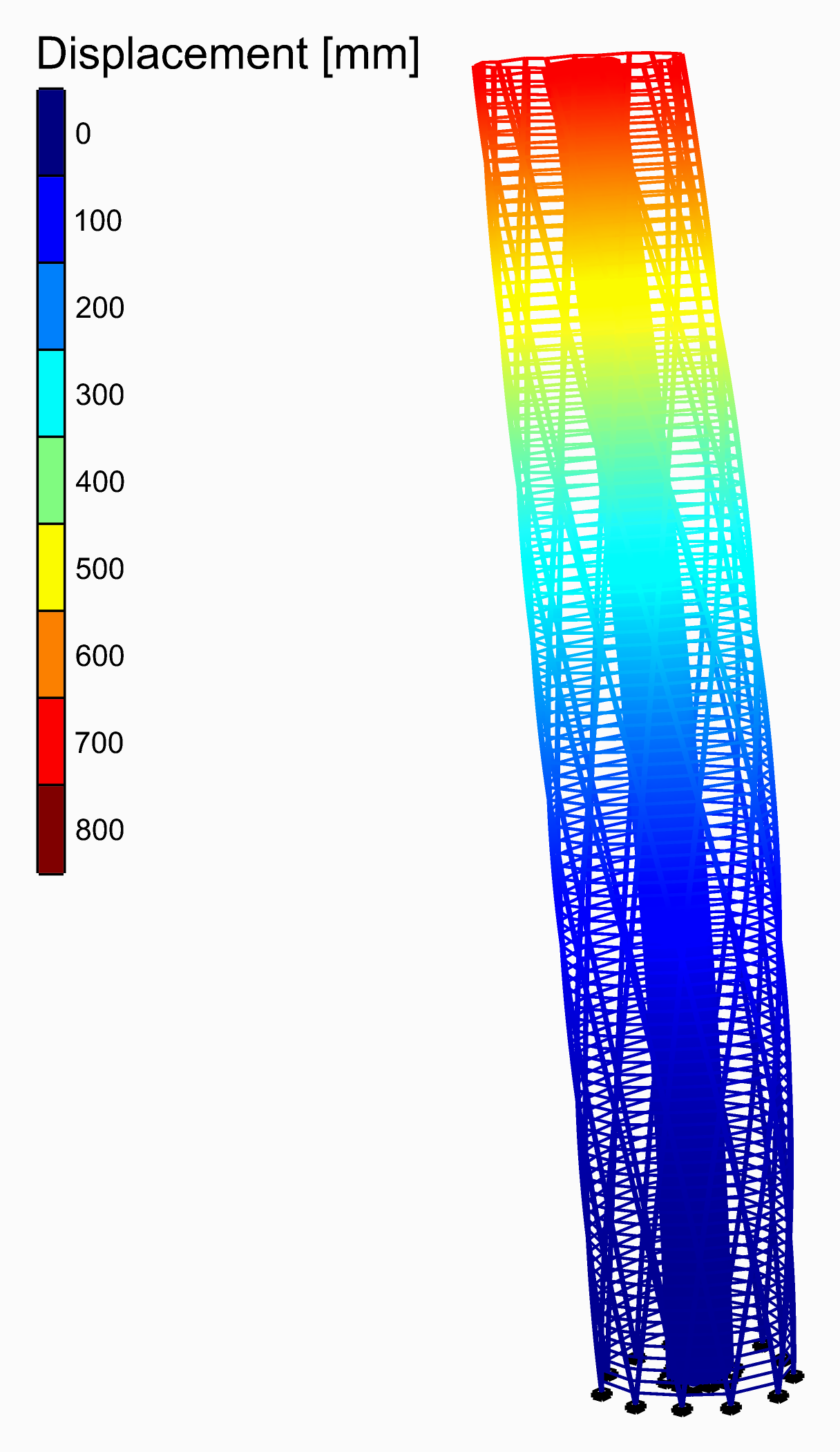
| 6 - Results | A Model View of the analysed model at Step, deformed 40 times, its supports drawn, its colours over 0 to 800 mm for every step alike, with a Legend. Drag Step to go through the record. |
Its 6 100 elements are past the free limit of 50: it needs a licence. The analysis takes about five minutes on a laptop; then each step takes a second or a few to draw as you drag Step.
The ground motion
El Centro, 18 May 1940, the north-south component: 0.32 g at its peak, 2 s in, the first 31 s of it. A Path Time Series of its accelerations shakes the ground under the whole structure through a Load Pattern's UniformExcitation type, and Run Analysis follows it step by step, 0.02 s at a time, a transient analysis with Newmark's average acceleration. Damping is Rayleigh's, 2% of critical at two frequencies that bracket the modes that matter. Ground motion scale makes the record stronger or weaker, Duration takes more or less of it.
What it shows
The tower sways along x, its roof 719 mm off at the most, 13.1 s in; its first period is 8.7 s. The diagonals along the shaking work as the web of a tube, those across it as its flanges, stretching and squashing as the tower bends. It is a model of how the tower's structure works, made from its published shape and sizes, not a model of the tower itself: its members' sizes and its floors' mass are a designer's guesses, it is built in at the ground rather than standing on its foundations, and the real tower has much more in it.
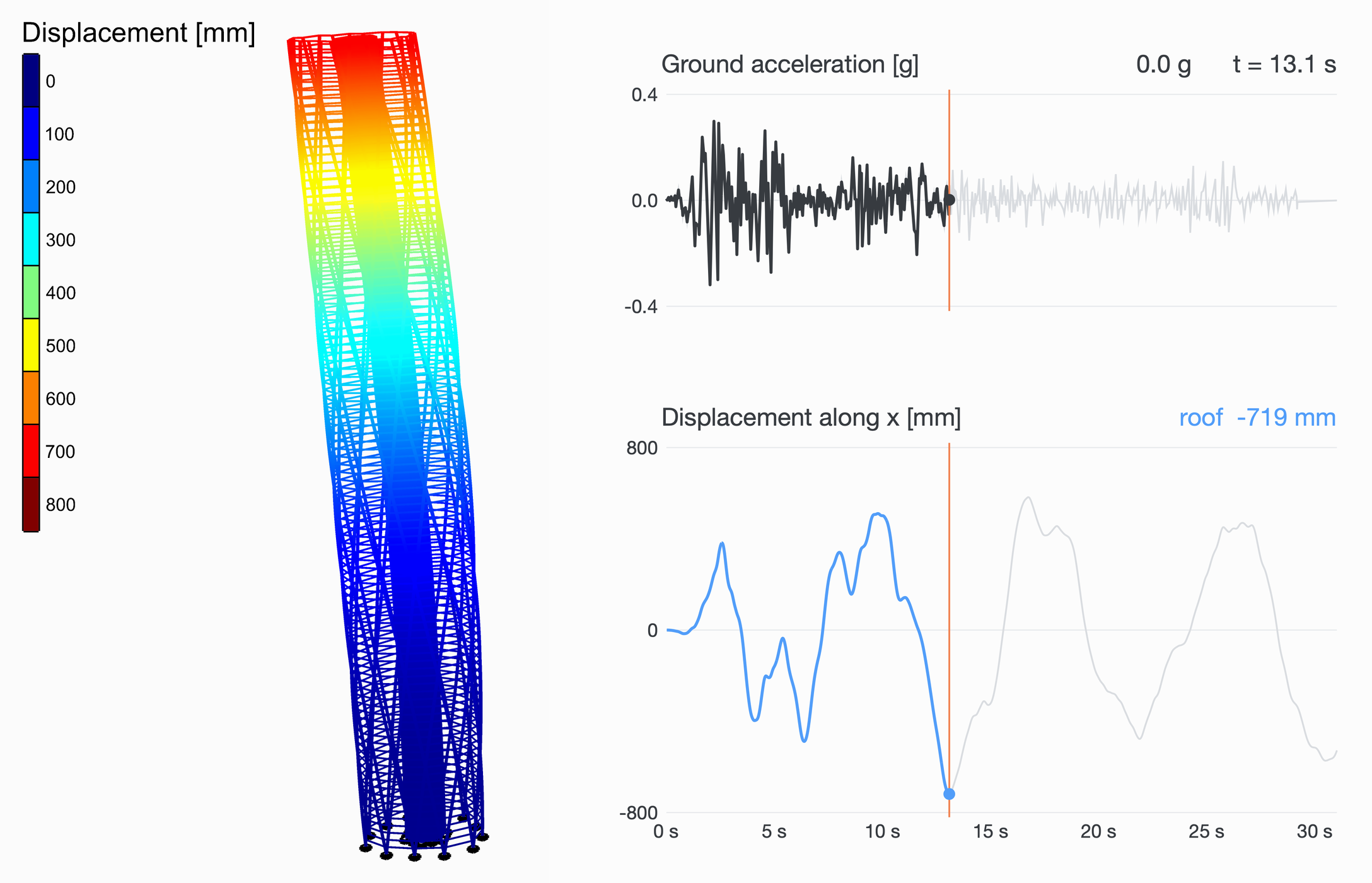
The moment it moves the most, and the record up to then.
Try
- Storeys a diamond at 6: flatter diagonals, which carry the sway better.
- Diamonds round it at 8 or 24: fewer, heavier diamonds, or more.
- Bulge half way up at 0: a straight tower.