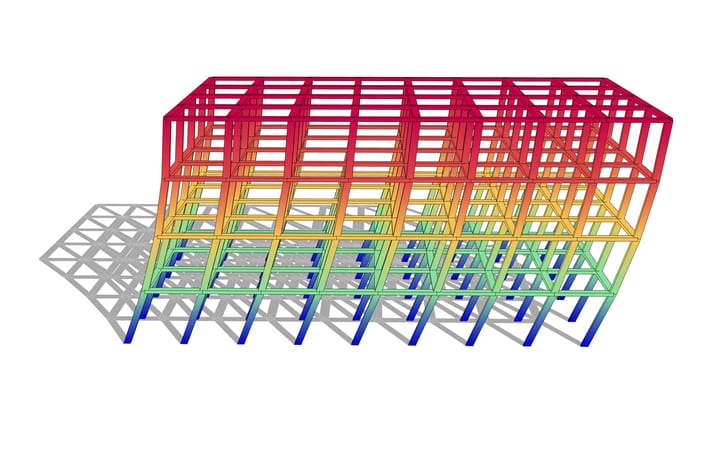
Thirty storeys of a concrete frame, four bays of 7 m each way, every floor turned 3° further round than the one under it: a quarter turn from the ground to the roof. The columns lean round the tower from floor to floor, each a straight piece a storey tall, and the beams and a 220 mm slab at every floor turn with them. The El Centro earthquake shakes the ground along x.
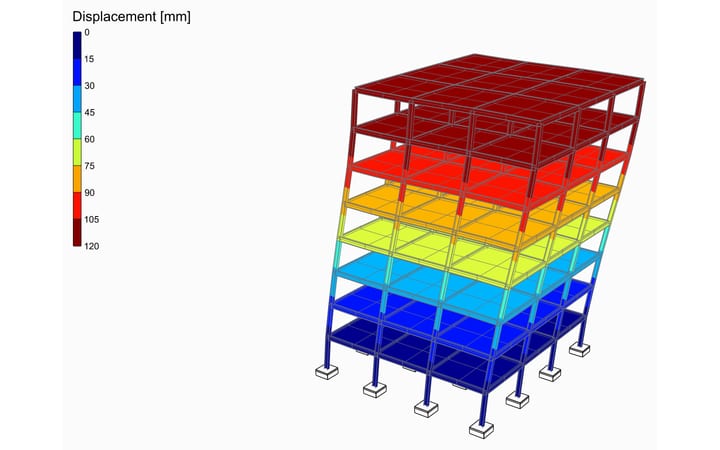
The first 20 s of El Centro, as they happened, the movement drawn larger than it is. Beside it, the ground's acceleration and the movement along x of the corner of the roof, over the same 20 s.
The model
| Group | What it does |
|---|---|
| 1 - Geometry | The sliders - Bays each way, Bay, Storeys, Storey height and Twist - and a Python component that draws the frame from them: each floor's grid turned about the middle by Twist times its height over the tower's, a column from each corner to the same corner a floor up, the beams cut twice a bay, a slab mesh at every floor, the columns' feet, and the corner of the roof the charts follow. |
| 2 - Members | Concrete C30/37 from Material Library; columns 1 × 1 m and beams 0.45 × 0.8 m, RectangleCS sections, as ForceBeamColumn; 220 mm of concrete, a Plate Fiber Section, as ASD Shells. |
| 3 - Supports | Every column built in at the ground, with a Support. |
| 4 - Ground motion | The El Centro record from a Python component, its first Duration seconds times Ground motion scale; a Path Time Series of it; a Load Pattern of the UniformExcitation type, along the direction it shakes. |
| 5 - Transient analysis | Assemble, with an MPCO Recorder of the displacements alone, which is all the view reads; Damping, Rayleigh's from Damping and its two frequencies; the Newmark Integrator; Analysis Step, a step a sample of the record; Analysis Settings for a transient analysis with the Linear algorithm, one solve a step, as an elastic model needs; and Run Analysis. |
| 6 - Results | A Model View of the analysed model at Step, deformed 15 times, its elements' edges and its supports drawn, its colours in iso-surfaces on the slabs over 0 to 400 mm for every step alike, with a Legend. Drag Step to go through the record. |
Its 5 070 elements are past the free limit of 50: it needs a licence. The analysis takes about three minutes on a laptop; then each step takes a second or a few to draw as you drag Step.
The ground motion
El Centro, 18 May 1940, the north-south component: 0.32 g at its peak, 2 s in, the first 20 s of it. A Path Time Series of its accelerations shakes the ground under the whole structure through a Load Pattern's UniformExcitation type, and Run Analysis follows it step by step, 0.02 s at a time, a transient analysis with Newmark's average acceleration. Damping is Rayleigh's, 5% of critical at two frequencies that bracket the modes that matter. Ground motion scale makes the record stronger or weaker, Duration takes more or less of it.
What it shows
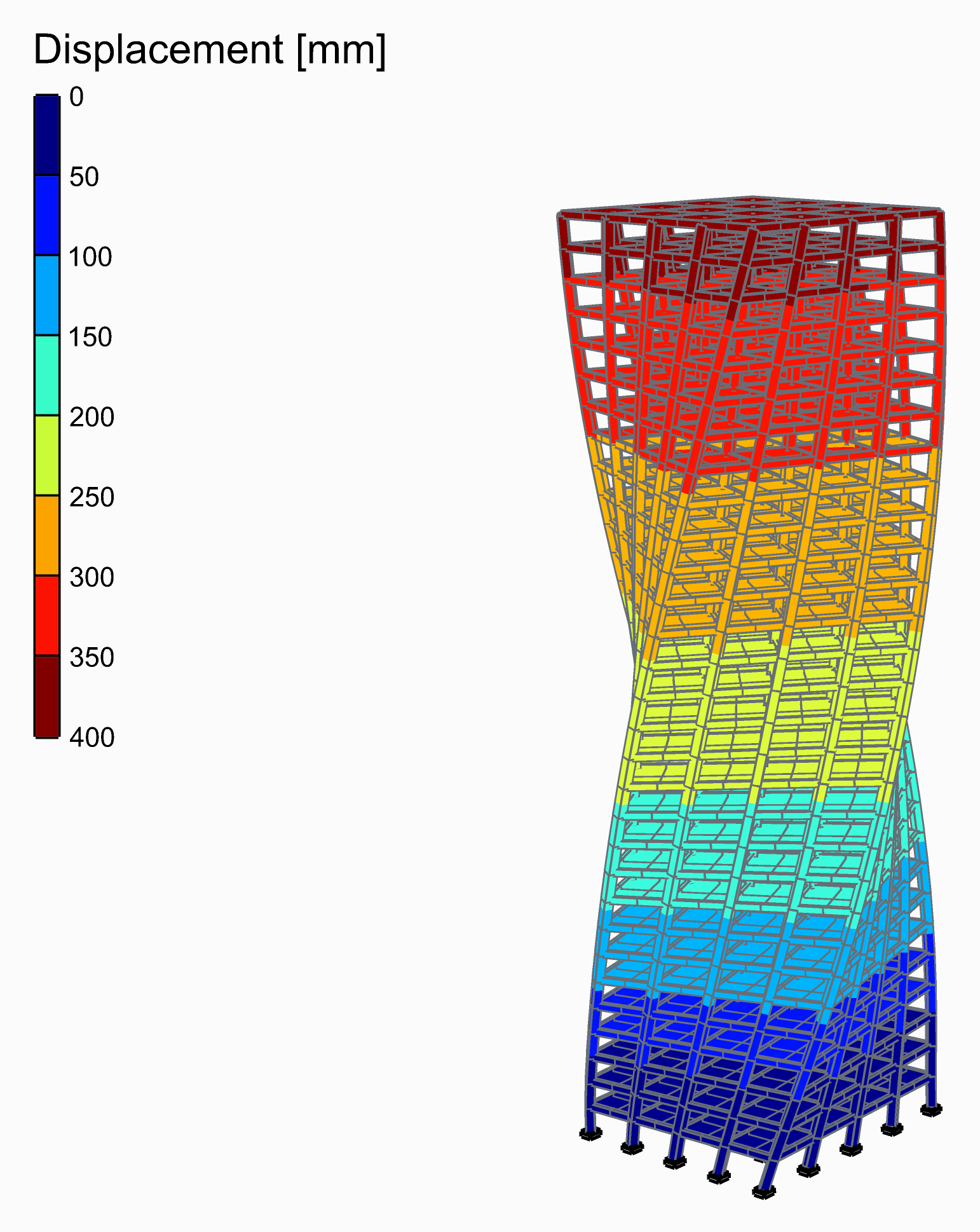
The tower sways along x, more the higher up: the corner of its roof moves 360 mm at the most, 4.9 s in. Twisted, it sways a little slower than it would straight - its first period is 3.2 s, against 2.6 s with Twist at 0 - as its columns lean. But it is stiffer in twist: the leaning columns brace it like a spiral, and its first twisting mode has a period of 1.6 s, against 2.1 s straight.
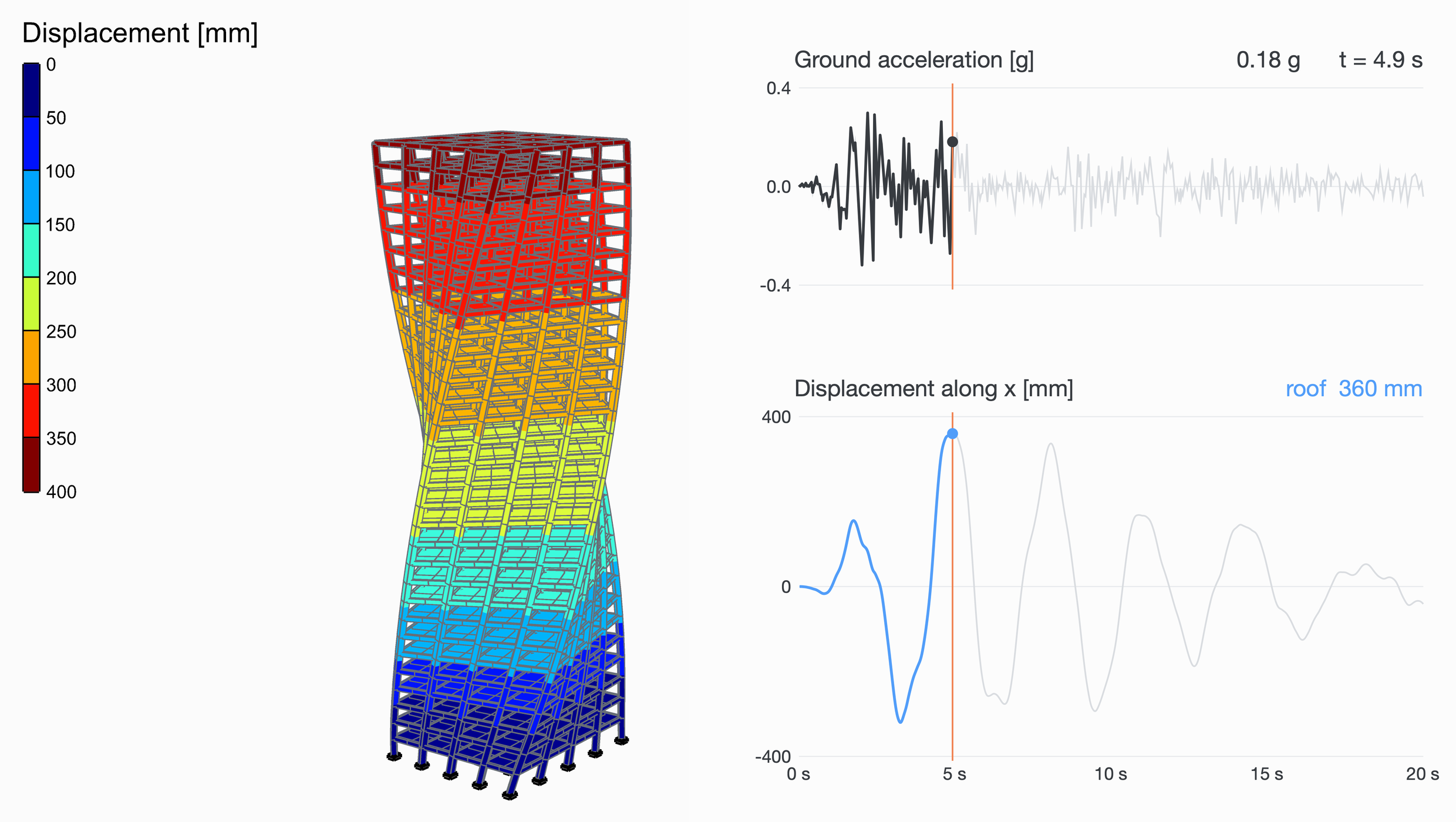
The moment it moves the most, and the record up to then.
Try
- Twist at 0 for a straight tower, at 180 for a half turn: compare their periods with a Natural Vibration Analysis on the same Assemble.
- Storeys: a taller tower sways slower and further.
- Ground motion scale at 2: twice the movement. The model is elastic, so everything scales with the ground.