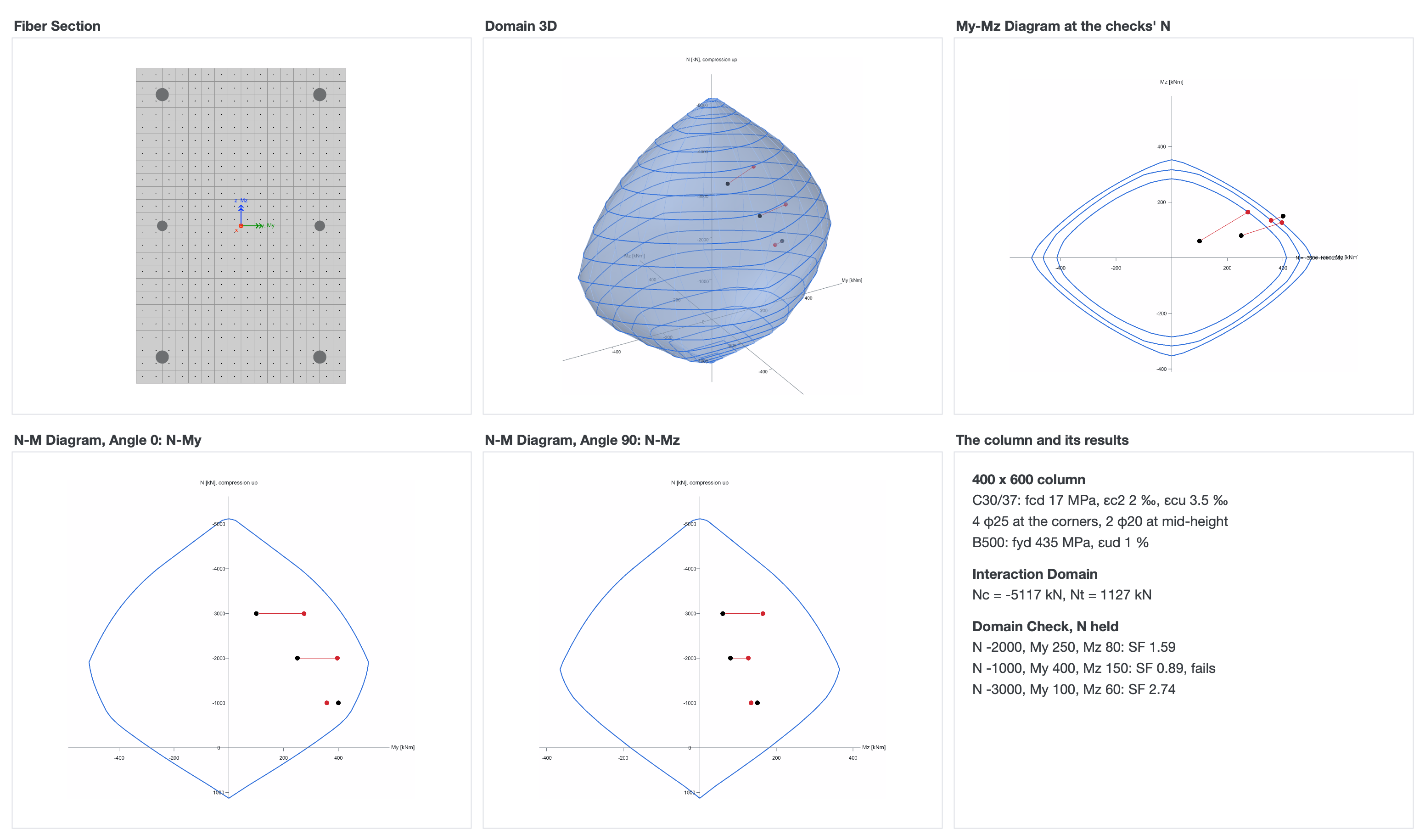
A 400 × 600 reinforced concrete column: its N–My–Mz resistance domain at the ultimate limit state from Interaction Domain, three combinations of design forces checked against it with Domain Check, and the domain drawn with the three views.
The model
| Group | What it does |
|---|---|
| 1 - Design materials | Concrete01 with fco = fcu = -17000 kN/m² (C30/37: 0.85 × 30 / 1.5 MPa), EpsilonCo = -0.002 and EpsilonCu = -0.0035: Eurocode 2's parabola–rectangle. Steel01 with fy = 434783 kN/m² (B500: 500 / 1.15 MPa) and b = 0: elastic–perfectly plastic. |
| 2 - Concrete and bars | The outline, a Rectangle 3Pt, meshed by Mesh Plane into 16 × 24 faces for a Patch: one fibre a face. A Fiber Point for each bar: φ25 at the corners, φ20 at mid-height, 50 mm to their centres. |
| 3 - Section and domain | Fiber Section and Interaction Domain, with its defaults: εud 1 % for the bars, and the concrete's own 3.5 ‰. Materials shows the limits each material is held to. |
| 4 - Checks | Three combinations of N, My and Mz in Domain Check, and a Method list to switch between holding N and scaling all three. |
| 5 - Views | Domain 3D, N–M Diagram and My–Mz Diagram, each on an XY plane of its own to the right of the section, with the checks drawn on them. |
What it shows
The axial resistances are what a hand calculation gives: in compression the concrete at fcd and the bars at Es εc2 = 400 MPa, as the strain is held to 2 ‰ in full compression; in tension the bars at fyd.
| kN | |
|---|---|
| Nc = −(fcd Ac + 400 MPa As) | −5117 |
| Nt = fyd As | 1127 |
| N | My | Mz | SF, Constant N | SF, Proportional |
|---|---|---|---|---|
| −2000 | 250 | 80 | 1.59 | 1.42 |
| −1000 | 400 | 150 | 0.89 | 0.88 |
| −3000 | 100 | 60 | 2.74 | 1.44 |
The second combination fails. With Method on Constant N each check's red point lies on the My–Mz diagram at its own N, as the figure shows; switch to Proportional and the third combination's factor drops from 2.74 to 1.44. It is mostly axial, so scaling N with the moments takes it towards the compression pole much sooner than holding N does.
INFO
The bars' area is not taken out of the concrete patch: the concrete is the full 400 × 600. Draw the patch with the bars' holes in it for the difference, a little under 1 % here.
Things to try
- Turn Angle on the N–M Diagram from 0 to 90: from the N–My diagram to the N–Mz one, through every skew cut between.
- Set εud to
0.0675, 0.9 εuk of a class B bar, and see how little the domain changes: 0.7 % more moment at N = 0, 1.5 % with 500 kN of tension, nothing at all in compression, where the concrete's limit governs. - Move a bar and watch the domain shift: moments are taken about the area centroid of every fibre, so an unsymmetric section's domain is off-centre.