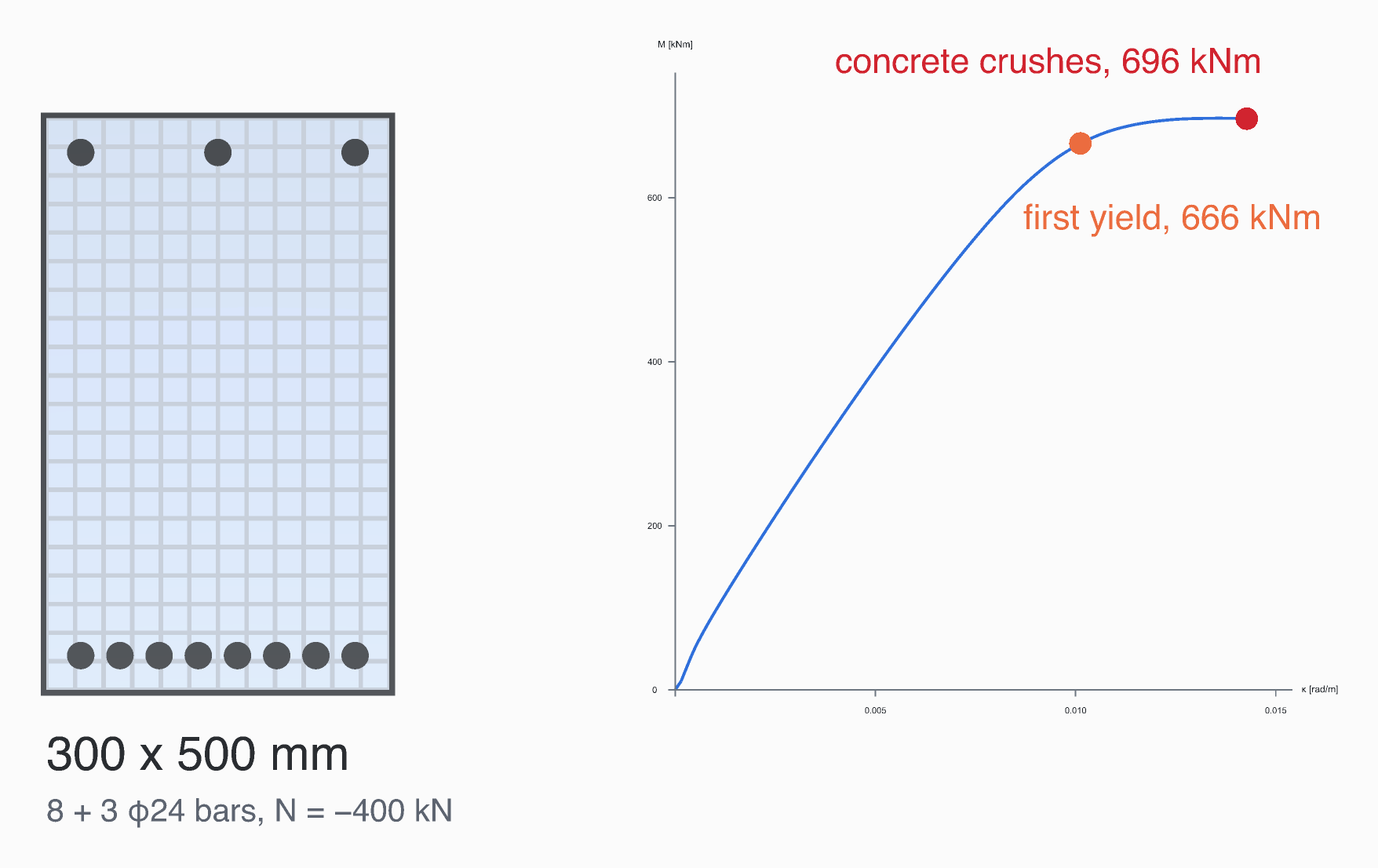
A 300 × 500 mm reinforced concrete section, bent until it fails while 400 kN of compression is held on it: Moment Curvature follows it fibre by fibre, and Moment Curvature Diagram draws the curve beside the section, with first yield and the ultimate state marked. Use it to see how the materials and the bars drive a section's stiffness, strength and ductility, and as a start for studies of your own sections.
The model
| Group | What it does |
|---|---|
| 1 - Materials | Concrete01 and ReinforcingSteel, with their presets. |
| 2 - The section | The outline, a Rectangle 3Pt 300 × 500 mm, meshed into 12 × 20 faces by Mesh Plane: a Patch of concrete, one fibre a face. φ24 bars 30 mm in from its short faces, eight along the bottom and three along the top, a Fiber Point each. Both into a Fiber Section. Sizes in metres: a fibre section is in metres and its materials in kN/m². |
| 3 - Moment Curvature | Axial -400 kN, compression, held while the curvature about the section's local y axis grows, in 200 increments, until the first fibre reaches its ultimate strain. Direction 180, so that the eight bars are the ones in tension. |
| 4 - Results | Panels with the moment at first yield, the ultimate moment and curvature, the curvature ductility, the cracked stiffness to first yield and which fibre failed; Moment Curvature Diagram draws the curve beside the section, 0.5 m across. |
What it shows
With the eight bars in tension, the section first yields at 666 kN·m and reaches 696 kN·m at a curvature of 0.0143 rad/m, where the concrete crushes at its top corner (εcu 3.5 ‰): a curvature ductility of 1.4. Its cracked stiffness to first yield, EI, is 65 800 kN·m², about half the uncracked section's.
Bent the other way, Direction 0, the three bars are in tension: it yields at 329 kN·m and reaches 359 kN·m, half as strong, but at 0.0249 rad/m, where a bar reaches its ultimate strain first, with a ductility of 3.7. Eight bars in tension make the section strong and brittle: the concrete gives out before the steel has stretched far. Three make it weaker and ductile.
What to try
- Sweep the axial force. Feed a range into Axial (negative for compression) and watch the ductility fall as the compression grows. For the whole M–N interaction at the ultimate limit state use Interaction Domain instead.
- Bend it the other way. Direction 0 bends it about y the other way: the three bars go into tension, and the section is weaker but far more ductile.
- Bend it off its axes. Give Direction an angle,
30say: the moment holds that direction and the neutral axis turns as it needs to. - Change the bars. The bar counts and size are at the top of
MomentCurvature.py; on the canvas, add points and areas to the Fiber Point. - Refine the patch mesh. Each face is one fibre, so the mesh density is the fibre density: Mesh Plane's counts.
- Unpack the fibres. Fiber Stress Strain gives the stress and strain history of every fibre.
See Moment Curvature for the reference documentation on each component.